Minor Arcana · Cups · water
Knight of Cups
The Book T title
The Prince of the Chariot of the Waters in Book T, and the Prince rank matters here more than in any other suit. A Prince acts on inherited authority rather than his own, which in water produces someone whose feelings are entirely genuine and not entirely his own to dispose of. This is the courtly figure of the deck — the one who arrives with an offer already composed — and the title’s chariot is the giveaway: he is being carried as much as riding. Book T makes the ranks elemental in their own right, which is the most useful and least circulated fact about the court cards. The King is fire, the Queen water, the Knight air, the Page earth, and each modifies its suit. This card is therefore air of water — wind over a surface, which produces movement without depth being disturbed. That is exactly the card: the approach is real and it is happening at the top of the water. It also accounts for the figure’s particular fragility, since wind on water is the one combination in the scheme that stops the moment the wind does.
Upright meaning
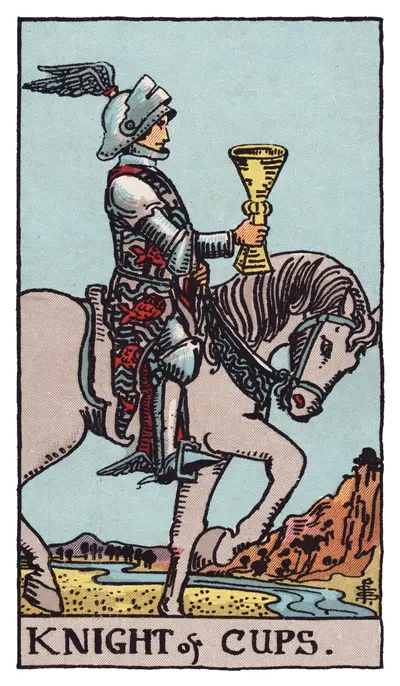
A rider on a white horse moves at a walk, holding a cup forward in one hand, wearing a winged helmet, with a stream and trees behind him. It is the calmest Knight by a wide margin. The Knight of Cups is the approach — an offer, a proposal, an invitation, extended deliberately and at a pace that allows it to be refused. What distinguishes it from the other three Knights is that the pursuit here is courteous: the horse is walking, the cup is held out rather than carried, and nothing about the gesture is urgent. When it arrives, somebody is making an approach, or the querent is about to. The card is genuinely romantic in the old sense, which means it is as much about the form of the gesture as its content. Its honest limitation is that a beautifully made offer says nothing about what is inside the cup, and the card declines to show that.
Reversed meaning
Reversed, the offer loses substance. The commonest reading is a gesture without follow-through — charm as a mode rather than a means, which is the specific failure this figure risks. A second concerns the recipient rather than the giver: an approach that has been made and not answered. A third is worth offering because it is frequently the case: sincerity that cannot sustain itself, where the feeling was real at the moment of offering and did not outlast the ride. Where the reading involves somebody else the first applies; where it involves the querent, the third.
Why this card spans two signs
This Knight holds the last twenty degrees of Libra running into the first ten of Scorpio, which accounts for the card’s particular texture better than the suit does. The closing decans of Libra are concerned with grace and with what is owed between people; the opening of Scorpio is depth and consequence. A figure spanning that seam offers beautifully and means it seriously, which is an unusual combination and is exactly what the image shows. The twelve spanned court cards each cover thirty degrees in this way, with the joins deliberately falling inside signs.
Read as a person
Read as a person, the Knight of Cups is someone who leads with feeling and expresses it well. They are attentive, romantic in the broad sense, and their sincerity is real while it lasts — the question the card raises is duration rather than honesty. In readings about other people this figure is almost always the one making the approach. As the querent it describes being in a mode of offering something emotionally, which is a vulnerable position the card treats with respect: the cup is held out at arm’s length, where it can be taken or refused. Whether a court card means another person, the querent or the situation is the standing difficulty with these sixteen, and no rule in the tradition settles it. The tell in this one is direction. The cup is extended outward, so if somebody in the reading is making an approach, this figure is them. If the querent is the one composing the message, it is the querent, and the card is unusually willing to be read that way — more people recognise themselves in the offering than in the receiving. As a situation it describes a moment when something is available and has not yet been answered.
What is on the card
The horse walks and its head is lowered, the only calm mount among the four Knights. Wings sit on both the helmet and the heels, the attributes of Mercury the messenger, which is the image saying this figure is carrying something. The tunic is covered in fish, the emblem of the suit. The cup is held forward and level, offered rather than drunk from. A stream crosses the foreground and the trees beyond are in leaf. Nothing in the landscape is difficult.
In a love reading
The classic approach card, and one of the more welcome to draw on a relationship question. It describes an offer being made with care — an invitation, a declaration, a reconciliation attempted properly. It is favourable and it is specifically about the gesture rather than the outcome, which is worth preserving in a reading. On questions about whether someone will make a move it is among the clearest affirmatives in the deck. On questions about whether the feeling will hold, the walking horse and the winged heels point in different directions, and the card does not resolve them.
In a career reading
A proposal, a pitch, or a negotiation conducted with unusual grace. It is also the card of the colleague who is very good in the room and whose work needs checking, which is a real type and rarely named kindly. On questions about creative or client-facing work it is favourable. Its limitation on ordinary advancement questions is that nothing in the image involves effort: the horse is walking and the rider is carrying one object.
How this one is usually misread
The persistent error is reading this as insincerity — the charming figure whose offer is hollow. That is the reversed reading imported upright, and the image does not support it: the horse is walking, which is the slowest and most considered approach available, and a figure intending to deceive would not move at that pace. The second misreading is assuming the cup is empty because the card does not show what is in it. It shows an offer being made properly, and what is inside is genuinely outside the card’s scope. A reading that supplies contents has invented them in either direction.
How it behaves beside other cards
With the Two of Cups the offer is accepted and returned. Beside the Five of Cups somebody approaches a person who is still looking at what was spilled. With the Seven of Cups the offer is one option among several imagined ones. Next to the Page of Cups the approach follows an unguarded first move. Its most testing neighbour is the Knight of Swords, where two entirely incompatible modes of pursuit sit side by side. Beside the Three of Cups the approach happens somewhere public. With the Queen of Swords the offer meets somebody who will assess it accurately, which is the least romantic and most informative thing that can happen to this card.
Why this card spans two signs
The twelve court cards above Page each cover the last twenty degrees of one sign and the first ten of the next, so the twelve of them tile the circle once with the seams falling inside signs rather than between them. Knight of Cups runs from Libra into Scorpio. Pages take a whole seasonal quadrant instead and have no degree span.
Correspondences follow the Golden Dawn attributions set out in Book T. Degrees are computed from each card’s position in the decan sequence rather than transcribed, so they cannot drift from the spread tool on the rest of this site.
Cards next to this one
See this card come up in your own chart
The spread on our tarot astrology page reads your chart positions as cards — no shuffle, the same answer every time. The daily card does the same for the Moon’s decan right now.