Minor Arcana · Cups · water
King of Cups
The Book T title
The Lord of the Waves and the Waters, King of the Hosts of the Sea — the Golden Dawn’s Knight of Cups, which in RWS ranks is our King. Book T makes each rank elemental in its own right, the single most useful fact the tradition supplies about the court cards: King is fire, Queen water, Knight air, Page earth, each modifying its suit. This card is fire of water, and the compound is the whole of it. Fire in water is heat under a surface that shows nothing — the most difficult of the twelve compounds to hold, and the only one where the two elements genuinely oppose each other. Every reading of this figure as composed is a reading of what it costs to be that compound.
Upright meaning
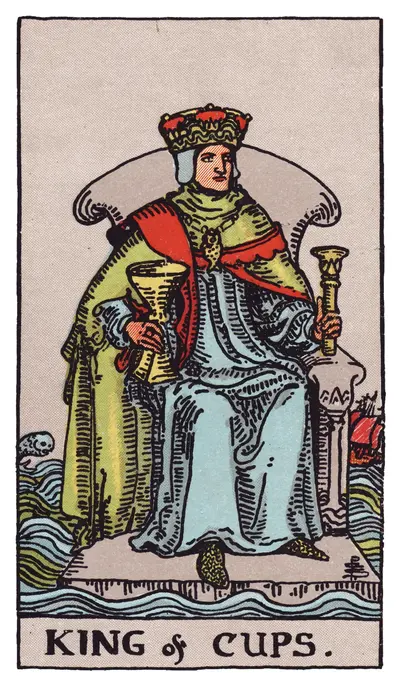
A man sits on a throne that is itself floating on a turbulent sea, holding a cup in one hand and a sceptre in the other, wearing a fish amulet. A ship rides the swell on one side and a dolphin breaks the surface on the other. Nothing beneath him is stable and he is entirely still. The King of Cups is emotional mastery — feeling fully present and fully governed, which is a harder and rarer achievement than either suppressing it or expressing it. What separates him from the Queen of the same suit is that she holds the water and he sits on it. When he arrives, the matter involves somebody who is managing a difficult emotional situation without being moved by it, and the card’s quiet claim is that this is a skill rather than a temperament. His feet are dry. The sea is not calm.
Reversed meaning
Reversed, the governing fails. The commonest reading is emotion managed into unavailability — control that has become distance, which is the natural failure of fire in water. A second is the opposite and rarer: the composure cracking, which is alarming precisely because this figure does not do it lightly. A third concerns manipulation, and the tradition is old on this point: a person who understands feeling this well and has stopped being honest about their own is the most quietly dangerous court card in the deck. Where the surrounding cards are interpersonal the third is worth weighing.
Why this card spans two signs
This King holds the last twenty degrees of Aquarius running into the first ten of Pisces, which is a cooler span than the suit implies and accounts for the card’s particular restraint. The closing decans of Aquarius are detached and principled; the opening of Pisces is boundaryless feeling. A figure spanning that seam feels everything and processes it at a distance, which is exactly the posture the image shows. The twelve spanned courts each cover thirty degrees, with the joins falling inside signs rather than between them.
Read as a person
Read as a person, the King of Cups is somebody others bring crises to. They are steady, perceptive and hard to read, and the steadiness is maintained rather than natural. Their characteristic strength is that a difficult situation does not get worse in their presence. Their characteristic cost is that almost nobody asks how they are, because the composure reads as not needing it. Whether a court card means another person, the querent or the situation is the standing problem with these sixteen, and nothing in the image resolves it. The tell here is who is holding things together. Where somebody is absorbing a situation so that others do not have to, that is this card, and it is the querent more often than querents expect. As a situation it means circumstances that are turbulent and being contained.
What is on the card
The throne is a stone block floating on open water, unmoored and unexplained — the most physically impossible object in the deck and the card’s central image. A fish amulet hangs at his neck, the suit’s emblem worn rather than held. He holds a cup and a sceptre, the only court figure carrying both an emblem and a sign of office. A ship rides the swell behind his right shoulder and a dolphin leaps at his left. His robes do not touch the water. The sea is visibly rough. Set the four Kings side by side and the differences are unmistakable, because Smith drew them as variations on a single chair. The King of Wands is half out of his, the King of Swords is squared to the viewer, the King of Pentacles is planted in a walled garden with solid ground underneath — and this one has no ground at all. His throne is floating. Of the four offices, three are exercised from somewhere stable and this one is exercised from a block of stone on open water, which is the image making the card’s entire claim in a single structural decision rather than in anything the figure is doing.
In a love reading
Somebody emotionally reliable, or a relationship in which one person is doing the steadying. It is among the most favourable court cards on a question about whether a partner can be depended on in difficulty, and among the least informative about whether they are happy. On questions about communication it is a real caution: this figure processes privately, and a relationship where that is the only mode accumulates a great deal that is never said. On questions about somebody’s feelings, the card confirms they are strong and does not confirm they will be shown.
In a career reading
Anybody whose job involves other people’s difficulties — management, medicine, law, mediation, crisis work of any kind. It is one of the strongest cards for questions about whether the querent can handle a fraught professional situation. On questions about a superior it indicates somebody fair and unreadable. On questions about advancement it is quiet, since this figure’s competence is the kind that is noticed only when it is absent.
How this one is usually misread
The persistent error is reading the calm as the whole card. The sea under the throne is rough and the throne is floating on it without support, which is the image insisting that the composure is work. Delivered as serenity the card loses its subject entirely. The second misreading is assuming a King of Cups is warm. Fire of water is a governed compound, not an affectionate one, and the reversed reading of manipulation exists because the tradition has always known that this degree of emotional understanding is a capability before it is a virtue.
How it behaves beside other cards
With the Queen of Cups two kinds of emotional competence sit together and the reading usually turns on which the situation needs. Beside the Three of Swords he is the person who will handle it without flinching. With the Devil the emotional understanding acquires a use nobody should want. Next to the Ten of Cups the containment is no longer necessary. Its most revealing neighbour is the Knight of Cups, where the same suit appears at the surface and the contrast between offering and governing is the whole reading.
Why this card spans two signs
The twelve court cards above Page each cover the last twenty degrees of one sign and the first ten of the next, so the twelve of them tile the circle once with the seams falling inside signs rather than between them. King of Cups runs from Aquarius into Pisces. Pages take a whole seasonal quadrant instead and have no degree span.
Correspondences follow the Golden Dawn attributions set out in Book T. Degrees are computed from each card’s position in the decan sequence rather than transcribed, so they cannot drift from the spread tool on the rest of this site.
Cards next to this one
See this card come up in your own chart
The spread on our tarot astrology page reads your chart positions as cards — no shuffle, the same answer every time. The daily card does the same for the Moon’s decan right now.