Minor Arcana · Wands · fire
Page of Wands
The Book T title
The Golden Dawn calls this figure the Princess of the Shining Flame, and unlike the other three court ranks the Pages are not given a zodiacal span at all — each rules a quadrant of the heavens, a quarter of the world rather than an arc of the wheel. That is a different kind of jurisdiction and it is why the Pages read as less formed than the other courts: they are not located, they are the territory itself.
Upright meaning
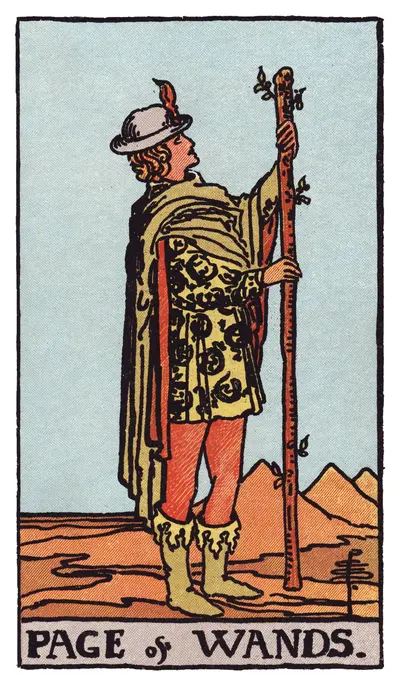
A young figure in a patterned tunic stands in a desert holding a budding staff and looking up at it. Salamanders decorate the clothing and three pyramids sit on the horizon. The Page of Wands is enthusiasm before competence — the stage at which the appetite is entirely real and the skill has not arrived. What makes it a useful card rather than a dismissive one is that the enthusiasm is not naive; the figure is looking at the staff with attention, as if working out what it is for. When it arrives, the thing being asked about involves someone at the beginning of something, and that someone is frequently the querent regardless of age. Pages are traditionally read as messages as well as people, and for this suit the message is characteristically an invitation or a piece of news that generates appetite. The card carries no guarantee that the enthusiasm survives contact with the work. The Pages have always carried a second meaning alongside the person, and it is worth holding both: they are messengers. In older decks the rank is the household servant who arrives with news, and the tradition has never dropped that reading. What arrives for this suit is characteristically an invitation rather than information — something that generates appetite rather than requiring a decision, which is why the figure in the image is looking up the length of the staff rather than reading anything. When the Page of Wands turns up in a spread about a situation rather than a person, the useful question is what has recently been proposed, and whether the querent noticed how much they wanted it.
Reversed meaning
Reversed, the enthusiasm falters or misdirects. The commonest reading is a false start — energy that arrived and dissipated, which is the natural failure mode of an appetite without a method. A second concerns impatience: the Page wanting the result without the apprenticeship, which is the specific weakness of the rank. A third is favourable and under-offered: news delayed rather than bad, since the Pages carry messages and a reversed messenger is more often late than lying.
Why this card spans two signs
Pages have no 20-to-20 span, which is the structural fact that separates them from every other court card. The King, Queen and Knight of each suit each straddle two signs; the Page is assigned an entire quadrant of the heavens instead — for Wands, the fiery quarter. That is why this figure cannot be resolved from a chart position the way the other courts can, and it is also why the Pages are the most elemental of the sixteen: they are not a blend of two signs but the undiluted quality of their element in its youngest form.
Read as a person
Read as a person, the Page of Wands is someone young in the thing rather than young in years — new to a craft, a role or an interest, and visibly excited about it. They are generous with energy and unreliable about follow-through, and both of those are the same trait. In a reading about someone else this figure is frequently the person who brought the situation to the querent’s attention rather than the person it concerns. As a description of the querent it indicates being at the start of something with more appetite than experience, which is a position the deck treats with respect rather than condescension.
What is on the card
The salamanders on the tunic are fire elementals in the old scheme, and several of them are drawn with their tails not yet in their mouths — incomplete circles, which is the costume itself saying this figure is unfinished. The staff is budding, the same living branch as the Ace, and the Page holds it with both hands while looking up its length. The setting is desert with three pyramids behind, the driest landscape in the deck. A feather rises from the hat, echoing the same feather on the Fool and on the other Wands courts.
In a love reading
The beginning of an attraction, usually one with more energy than direction, and frequently someone making their interest obvious. It reads well on questions about whether someone is interested and poorly on questions about whether they will follow through, which is the rank’s characteristic limitation. It also describes a relationship in its earliest and least considered phase, where the appetite is genuine and nothing has been tested.
In a career reading
A new role, a training position, or a piece of news that opens something up. It is common in questions about starting out in a field and about junior colleagues. On questions about whether to pursue an interest it is encouraging and says nothing about whether the interest will last, which is a real limitation rather than a hedge. As a message it usually concerns an opportunity rather than a decision.
How this one is usually misread
The habitual error is reading the Pages as children, which flattens them into a demographic and loses the rank’s actual meaning. A Page is someone at the beginning of a thing, and a sixty-year-old learning a new trade fits the card exactly. Delivered as "a young person" in a reading about work, it sends the querent looking for the wrong figure entirely. The second misreading is dismissal. Enthusiasm without skill is a real and necessary stage, and readings that treat the Page of Wands as merely immature have made a judgement the deck does not make — the salamanders with open tails are a statement of incompleteness, not of failure.
How it behaves beside other cards
With the Eight of Pentacles the enthusiasm acquires a discipline, which is the most constructive thing that can happen to this card. Beside the Knight of Wands the same energy has become momentum. With the Ace of Wands the offer and the appetite arrive together. Next to the Ten of Wands the newcomer is walking into a situation already overloaded. Its most sobering neighbour is the Seven of Pentacles, where the patience this figure lacks is exactly what the situation requires. Beside the Queen of Wands the enthusiasm meets somebody who has had it for twenty years and still has it, which is the best possible thing this card can be shown. With the Five of Wands the newcomer walks into a contest nobody is going to explain. With the Hermit the enthusiasm meets somebody who will not be hurried. Beside the Sun the enthusiasm is warranted.
Why this card spans two signs
The four Aces are the root of their element rather than a place in the zodiac. Page of Wands is the root of Fire. A card with no span cannot be drawn from a chart position, which is exactly why the spread tool never returns one.
Correspondences follow the Golden Dawn attributions set out in Book T. Degrees are computed from each card’s position in the decan sequence rather than transcribed, so they cannot drift from the spread tool on the rest of this site.
Cards next to this one
See this card come up in your own chart
The spread on our tarot astrology page reads your chart positions as cards — no shuffle, the same answer every time. The daily card does the same for the Moon’s decan right now.