Minor Arcana · Swords · air
Page of Swords
The Book T title
The Princess of the Rushing Winds, and the title is more energetic than the rank suggests in English. Like the other Pages this figure holds a quadrant of the heavens — the airy quarter — rather than an arc of the zodiac, which places them outside the system of blended signs the other courts inhabit and makes them the least diluted expression of their element. The rushing winds in the title are not decorative — every element in the card is in motion, and the Golden Dawn name is describing the quality of attention rather than the weather.
Upright meaning
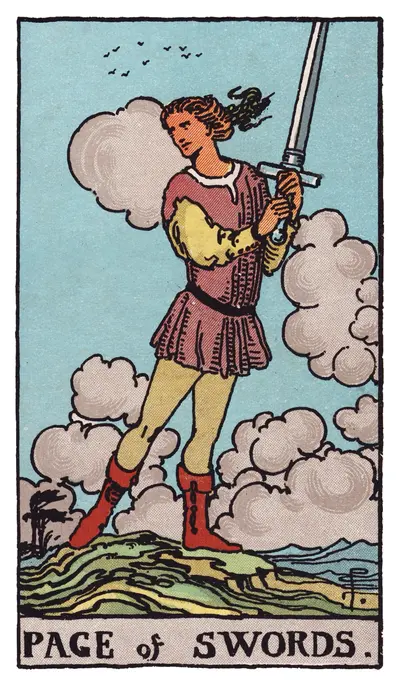
A young figure stands on rough ground with a sword held up in both hands, hair and clouds streaming, birds scattered across a turbulent sky. The stance is alert and slightly off-balance. The Page of Swords is watchfulness — curiosity with an edge on it, the mind sharp and not yet disciplined. What separates it from the other Pages is that this one is looking around rather than at the object in their hands: the figure is scanning. When it arrives, the thing being asked about involves information, observation or someone paying close attention, and the card is deliberately ambiguous about whether that attention is benign. As a message it traditionally carries news that requires a response, and often news that somebody would rather had not travelled. The wind in the image is doing real work — everything in the frame is moving, which is why the card reads as vigilance rather than study. All four Pages are messengers as well as people, and the reading is older than the modern one. The rank is the servant who arrives with news, and the suit says what kind of news. For Swords it is information that requires something of the recipient — a fact that has to be acted on, a piece of the situation that has come to light, occasionally a message somebody would have preferred not to travel. The ten birds scattering across the sky are the tradition drawing exactly that. Where the card appears in a spread about circumstances rather than a person, the useful question is what has recently been found out and by whom.
Reversed meaning
Reversed, the watchfulness turns. The commonest reading is gossip or information used carelessly, which is the rank’s characteristic failure. A second is scattered attention: curiosity with no object, which the turbulent sky already threatens. A third concerns the querent being watched rather than watching, which is a specific and uncomfortable reading the surrounding cards usually confirm. Reversed, this Page is the least benign of the four and a reader should not soften that automatically.
Why this card spans two signs
The Pages hold no 20-to-20 span. The King, Queen and Knight of each suit each straddle two signs; the Page rules a quadrant of the heavens, for Swords the airy quarter. That is the technical reason a chart position never resolves to a Page — the other twelve courts each occupy thirty degrees of the wheel and this one occupies a quarter of the sky — and it is why the Pages express their element without a second sign shaping it.
Read as a person
Read as a person, the Page of Swords is someone who notices things and says them. They are quick, often young in a role rather than in years, and their relationship to information is enthusiastic rather than careful — they have not yet learned which facts do damage. In readings about other people this figure is frequently the one who has found something out. As the querent it describes being in a position of gathering rather than concluding, which is useful as long as it does not become a substitute for deciding.
What is on the card
The sword is held upright in both hands but angled, not vertical, so the guard is imperfect. Ten birds scatter across the sky, and the clouds are drawn in motion. Trees in the middle distance bend in the wind. The ground beneath is a rough hillock rather than level. The figure stands with feet apart and weight forward, looking off to the left rather than ahead — the only court card whose gaze is directed outside the frame entirely.
In a love reading
Communication that is direct and possibly unguarded, or someone asking questions about a relationship rather than being in it. It appears in situations where something is being found out. On questions about honesty it is favourable in an uncomfortable way: the information will surface. It reads poorly on questions about tenderness, since nothing in this card is soft, and the wind in the image makes it unlikely that anything said will stay where it was said.
In a career reading
Research, due diligence, a colleague who is paying more attention than expected. It is one of the better cards for questions about whether to investigate something and among the clearer warnings on questions about confidentiality. On questions about a new role it describes someone learning a system quickly and testing its edges, which is valuable and not always welcome. It also describes the specific value of somebody who has not yet learned which questions are not asked, which is genuinely useful to an organisation and genuinely uncomfortable to be around. On questions about whether to raise something awkward, this card is the argument for doing it.
How this one is usually misread
The frequent error is reading this as a spy or an enemy, which the turbulence and the raised sword invite and the card does not assert. This is a figure who notices things, and whether that is a threat depends entirely on the situation rather than on the card. Delivering it as a warning about a person manufactures a suspicion the image does not support. The second misreading is the general Page error: treating the rank as a child. A Page is someone at the beginning of something, and the Page of Swords is frequently a competent adult new to a subject and asking better questions than the people who have been there for years.
How it behaves beside other cards
With the Three of Cups the observation happens in a social setting and the pair supports a gossip reading neither card makes alone. Beside the Seven of Swords somebody is being watched who does not know it. With the Ace of Swords the noticing becomes a clear statement. Next to the Queen of Swords the same faculty appears in its developed form, and the two together describe a difference of experience rather than of kind. Its most useful neighbour is the Eight of Swords, where somebody can see the whole arrangement clearly and has not been asked. Beside the King of Swords the questions meet somebody who will answer them precisely and not kindly. With the Moon the watching produces more suspicion than information, which is this figure’s characteristic risk. Next to the Six of Swords the news is what prompts the crossing.
Why this card spans two signs
The four Aces are the root of their element rather than a place in the zodiac. Page of Swords is the root of Air. A card with no span cannot be drawn from a chart position, which is exactly why the spread tool never returns one.
Correspondences follow the Golden Dawn attributions set out in Book T. Degrees are computed from each card’s position in the decan sequence rather than transcribed, so they cannot drift from the spread tool on the rest of this site.
Cards next to this one
See this card come up in your own chart
The spread on our tarot astrology page reads your chart positions as cards — no shuffle, the same answer every time. The daily card does the same for the Moon’s decan right now.