Minor Arcana · Pentacles · earth
King of Pentacles
The Book T title
The Lord of the Wild and Fertile Land, King of the Spirits of Earth — the Golden Dawn’s Knight of Pentacles, our King. Book T gives every rank an element of its own, the fact that accounts for the courts better than temperament ever does: King is fire, Queen water, Knight air, Page earth. This card is fire of earth, which is the compound that turns ground into a going concern. Earth alone is material; fire in it is the thing that makes material productive — heat in soil, the forge, the impulse that builds rather than merely holds. It is why this figure is not simply wealthy. Wealth is the Ten of Pentacles. This card is the person who made it work.
Upright meaning
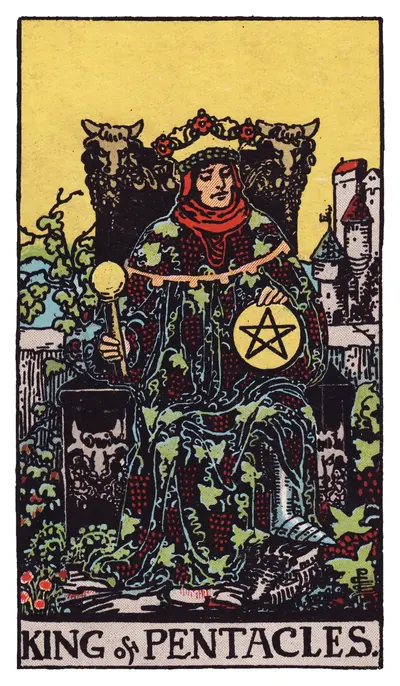
A man sits on a throne carved with bull heads, in a robe patterned with grapevines, holding a pentacle in one hand and a sceptre in the other. Vines grow up around him and a castle stands behind. He has one foot on a small stone lion and looks entirely settled. The King of Pentacles is material mastery — somebody who has built something substantial and knows how it works. What separates him from the Knight of the same suit is completion: the Knight is delivering and the King has delivered, more than once, and now holds the whole arrangement. When he arrives, the matter involves resources, provision, or somebody whose backing would change what is possible. The card is generous in a specific and slightly unromantic way: this figure gives out of surplus and expects the gift to be used well.
Reversed meaning
Reversed, the mastery narrows. The commonest reading is wealth without anything behind it — material success that has become the whole of the person, which is the failure this figure risks and the one the tradition warns about most. A second is stubbornness: an approach that built something and will not adapt now the conditions have moved, which is earth’s standing weakness. A third concerns control through provision, where support has become leverage. Where the reading involves family or a business the third is worth examining carefully.
Why this card spans two signs
This King holds the last twenty degrees of Leo running into the first ten of Virgo, and the combination explains him more precisely than the suit does. The closing decans of Leo are expansive and proprietary; the opening of Virgo is exacting and practical. A figure spanning that seam builds on a large scale and checks the detail personally, which is the combination that actually produces an estate rather than a windfall. The twelve spanned courts each cover thirty degrees this way, with the joins falling inside signs.
Read as a person
Read as a person, the King of Pentacles is somebody who has built something real and is comfortable in it. They are practical, generous within limits they have set, and not much interested in anything that cannot be demonstrated. Their characteristic strength is that they can be relied on materially and their word is a contract. Their characteristic narrowness is that they measure things, including people, by what those things produce. Whether a court card means another person, the querent or the situation is the problem all sixteen share. The tell here is resources: where somebody in the reading controls what is available, that person is this card. Where the querent is being asked to provide rather than to ask, it is the querent. As a situation it means circumstances that are materially secure and run by somebody.
What is on the card
Bull heads are carved into the throne — Taurus, the suit’s fixed sign — and grapevines cover both the robe and the frame, so the figure is literally wearing his own produce. He holds a pentacle in one hand and a sceptre in the other, the same pairing as the King of Cups. A castle stands behind him at a distance, the only built structure in the four Kings. His foot rests on a small stone lion. The ground beneath is solid, planted and enclosed — no water anywhere in the frame. The sceptre is worth a second look, because only two court figures in the deck hold one alongside their suit emblem — this King and the King of Cups. The other fourteen hold their emblem alone, or an emblem and a flower, or a sword that serves as both. Two hands, two objects: the thing the suit is about and the sign that somebody has been given charge of it. In a suit where the Knight is still delivering and the Page is still studying, the sceptre is the image’s way of saying that the question of who is responsible has already been settled here, and settled some time ago.
In a love reading
Somebody established, or a relationship in which stability and provision are the offer. It is among the most secure court cards on a relationship question and among the least exciting, which is not a criticism of either. On questions about whether a partner is dependable it is a strong yes. On questions about whether they are generous the answer is conditional: this figure gives readily and keeps track. Where a querent is worried about being a burden, the card is usually reassuring and is worth reading that way.
In a career reading
Business owners, investors, anybody who controls resources. It is among the strongest cards for questions about funding, backing or material security, and among the better ones for questions about whether a venture will hold. On questions about a superior it indicates somebody fair, unimaginative and good to work for. On questions about innovation it is weak: this figure trusts what has already worked, and the castle behind him was finished some time ago.
How this one is usually misread
The habitual error is reading him as merely rich, which confuses the card with the Ten of Pentacles. This is the person who built it — fire of earth, the compound that makes ground productive — and reading him as an inheritance discards the labour the image is full of. The second misreading is treating the Kings as a rank above the Queens. The four ranks are four elemental offices, not a ladder: the King is the fire of his suit and the Queen its water, which is why the Queen of Pentacles makes things grow and this figure owns the field. Neither outranks the other.
How it behaves beside other cards
With the Queen of Pentacles the estate and the household appear together and the pair is the most materially complete in the deck. Beside the Ten of Pentacles what he built has become something inherited. With the Eight of Pentacles he is the person the apprentice is working toward. Next to the Fool somebody is declining all of it, which is the sharpest contrast the suit can stage. Its most useful neighbour is the Ace of Pentacles, where the offer being extended is one this figure could tell you the real value of.
Why this card spans two signs
The twelve court cards above Page each cover the last twenty degrees of one sign and the first ten of the next, so the twelve of them tile the circle once with the seams falling inside signs rather than between them. King of Pentacles runs from Leo into Virgo. Pages take a whole seasonal quadrant instead and have no degree span.
Correspondences follow the Golden Dawn attributions set out in Book T. Degrees are computed from each card’s position in the decan sequence rather than transcribed, so they cannot drift from the spread tool on the rest of this site.
Cards next to this one
See this card come up in your own chart
The spread on our tarot astrology page reads your chart positions as cards — no shuffle, the same answer every time. The daily card does the same for the Moon’s decan right now.