Minor Arcana · Cups · water
Page of Cups
The Book T title
The Princess of the Waters, and like the other three Pages this figure holds a quadrant of the heavens rather than an arc of the zodiac — the watery quarter in its entirety. The Golden Dawn treats the Princesses as the thrones of their elements, which is a more substantial office than "page" suggests in English, and it is worth knowing before reading the rank as merely junior. The Princesses are also the only court rank the Golden Dawn assigns a governing role over a part of the earth rather than a part of the sky, which is a further reason the English title understates them.
Upright meaning
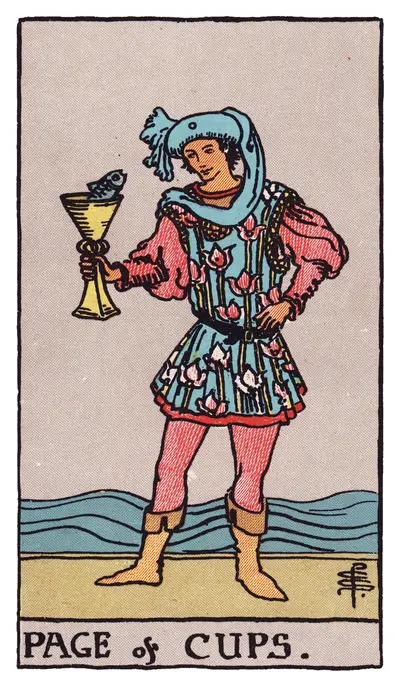
A young figure in a flowered tunic stands before a choppy sea holding a cup from which a fish is looking out. The figure is looking back at the fish with an expression of mild surprise. It is the strangest image in the court cards and the most charming. The Page of Cups is emotional openness before experience — the capacity to be surprised by feeling, and to find that funny rather than alarming. When it arrives, the thing being asked about involves something unexpected arriving in the emotional register: an approach, an admission, a piece of news that lands in the heart rather than the head. As a message, this Page traditionally carries the most welcome kind. The fish is the card’s argument: something has surfaced from water that was not supposed to contain anything, and the figure’s response is neither fear nor greed but curiosity, which is a genuinely rare thing to find depicted. Like all four Pages this one is a messenger as well as a person, and that half of the rank is older than the psychological reading. In earlier decks the Page is the servant who arrives with word from elsewhere, and the suit determines what kind. For Cups it is characteristically something that lands emotionally rather than practically: an admission, an apology, a message somebody has been working up to. The fish surfacing in the cup is the image of exactly that — something coming up out of water nobody expected to contain anything. When the card appears in a spread about a situation, the question worth asking is what somebody has been meaning to say.
Reversed meaning
Reversed, the openness becomes vulnerability or affectation. The commonest reading is emotional immaturity — feeling expressed without regard for its effect, which is the rank’s natural weakness. A second concerns the news: something emotional not arriving, or arriving and being mishandled. A third is worth offering because it is frequently the true one: sensitivity being performed rather than felt, which the card’s slight theatricality is always close to.
Why this card spans two signs
The Pages hold no 20-to-20 span. Where the King, Queen and Knight of each suit straddle two signs, the Page rules a quadrant of the heavens — for Cups, the watery quarter entire. That is why a chart position cannot resolve to a Page: the other twelve courts occupy thirty degrees of the wheel each and this one occupies a quarter of the sky. It is also why the Pages read as the purest expression of their element: no second sign dilutes them.
Read as a person
Read as a person, the Page of Cups is someone emotionally unguarded in a way that is disarming rather than naive. They say the thing, often before working out whether to, and the effect on a room is usually to make it more honest. In readings about other people this figure frequently indicates someone whose feelings are more visible than they realise. As the querent it describes being in a state where something can still surprise you, which is easy to lose and not easy to recover.
What is on the card
The fish in the cup is unique in the deck — no other card shows a creature emerging from a vessel — and it is traditionally read as intuition surfacing unbidden. The figure’s tunic is covered in lotus flowers and the pose is theatrical, hip cocked, one hand on the cup. Behind, the sea is distinctly choppy, which is the only part of the image that is not gentle. The hat and scarf are elaborate and blue. The figure is looking at the fish rather than at the viewer, which is the detail that makes the surprise legible.
In a love reading
A gentle overture, an unexpected message, or somebody being more open than the situation required. It is among the more favourable court cards on relationship questions, and it describes tone rather than outcome — the approach is sweet and the card says nothing about where it goes. It also appears where the querent is being invited to be less guarded than they have been, which is a reading worth offering carefully.
In a career reading
Creative work, an unexpected piece of good news, or a colleague who brings something fresh into a stale situation. It is weaker on questions about advancement than any other court card, since nothing in it concerns position. On questions about creative projects it is favourable and specific: the idea is arriving from somewhere unplanned, and the figure’s correct response is curiosity rather than immediate use.
How this one is usually misread
The common error is reading Pages as children and this one as a literal child or pregnancy, which is a long-standing tradition and wildly over-applied. It occasionally is that; it usually is not, and delivering it as a pregnancy card produces the most consequential possible false positive. The second misreading is treating the figure as weak. Emotional openness is a capacity rather than a deficiency, and the Golden Dawn ranks the Princesses as thrones of their elements rather than as apprentices — the English word "page" is doing damage the original title does not.
How it behaves beside other cards
With the Ace of Cups the surprise and the source arrive together. Beside the Nine of Swords somebody offers something kind and it is not registered. With the Knight of Cups the overture becomes an approach in earnest. Next to the Three of Swords the openness is about to cost something. Its most encouraging neighbour is the Two of Cups, where the offer is returned. With the Page of Swords the two youngest courts make a study in contrast: one says the thing because it is felt and the other because it is true, and neither has yet learned that those are different problems. Beside the Queen of Cups the openness meets its developed form, and the pair describes a difference in depth rather than in kind. With the Seven of Cups the surprise turns out to be one imagined option among several. Next to the Ten of Cups the feeling has somewhere to go. With the Hermit the openness meets someone who has deliberately stepped back from it. Beside the Moon the surprise is not what it appears to be, which is the one pairing that makes this figure worth watching rather than trusting.
Why this card spans two signs
The four Aces are the root of their element rather than a place in the zodiac. Page of Cups is the root of Water. A card with no span cannot be drawn from a chart position, which is exactly why the spread tool never returns one.
Correspondences follow the Golden Dawn attributions set out in Book T. Degrees are computed from each card’s position in the decan sequence rather than transcribed, so they cannot drift from the spread tool on the rest of this site.
Cards next to this one
See this card come up in your own chart
The spread on our tarot astrology page reads your chart positions as cards — no shuffle, the same answer every time. The daily card does the same for the Moon’s decan right now.