Minor Arcana · Swords · air
Four of Swords
Dates are for 2026 and shift by up to a day between years, because the tropical year is not a whole number of days.
The Book T title
Rest from Strife names the card with unusual precision, and both halves matter. Rest, and rest *from* something specific rather than in general — this is recovery after difficulty rather than leisure. Placed in the third decan of Libra, closing the sign, it is what the weighing of the Two and the sorrow of the Three resolve into when nothing more can be done for a while. Book T is describing a pause with a cause.
Upright meaning
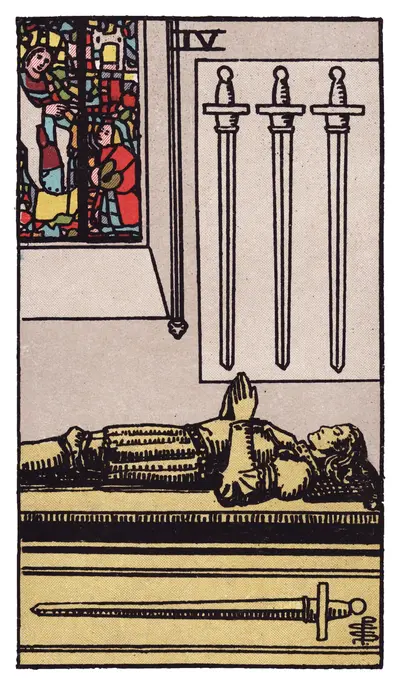
A knight lies on a tomb in a chapel, hands together, three swords on the wall above him and a fourth laid along the side of the tomb. It is the stillest image in the deck and one of the most misread, because a figure lying on a tomb reads as death and the card is not about death at all. What it depicts is deliberate withdrawal for repair. The fourth sword is not on the wall with the others — it is beside him, within reach, which is the detail that separates rest from surrender. When the Four of Swords arrives, the thing being asked about calls for stopping rather than pushing, and the card is unusually directive about it: this is one of the few cards in the deck that effectively gives advice. Four in the pips is stability, and in air stability means the mind has stopped generating. The stained glass window above shows a figure receiving a blessing, which places the stillness in a setting of care rather than defeat.
Reversed meaning
Reversed, the rest is interrupted or refused. The commonest reading is returning to activity, which can be timely or premature and the surrounding cards decide which. A second is the rest being unavailable — circumstances that will not permit a pause, which is a specific and frequently accurate description. A third and more useful one in practice is restlessness: the pause taken and not used, where the body has stopped and the mind has not, which is the most common failure of this card’s advice. It is rarely a negative reversal so much as a complicated one.
What Jupiter in Libra contributes
Jupiter in Libra is expansion in the sign of balance, and it is the most benign decan in a suit that is not generally benign. Jupiter restores; Libra restores *proportion*, which is what has been lost in the Two and the Three. The pairing accounts for the chapel rather than a bedroom — Jupiter supplies the sense of something larger holding the situation, and the stained glass is the image admitting it. It also explains why the rest in this card is effective rather than merely passive: Jupiter in a cardinal air sign does not stall, it re-inflates.
What is on the card
Three swords hang point-down on the wall and the fourth lies flat beside the figure, which is the whole argument of the card in one arrangement — most of the weaponry is stowed and one is kept to hand. The knight is an effigy in posture but the card gives no indication he is dead; his hands are in prayer. A stained glass window shows a figure kneeling before another, receiving something. The chapel is plain and the light is coloured. Nothing in the frame is in motion and nothing is damaged.
In a love reading
A relationship in a deliberate quiet period, or one person needing space that is not a rejection. It is a favourable card on questions about whether to give something time, and it is frequently literal about needing rest rather than needing distance. On questions after an argument it indicates a pause that will help, which is a more optimistic reading than it looks. It also appears in questions asked during a separation that both parties have agreed to, where it is considerably more favourable than the circumstances feel. The chapel in the image is a place people go to and come back from, and the card carries no implication that the pause is permanent.
In a career reading
Stepping back, taking leave, a project deliberately paused. It is among the most common cards in questions about overwork, and unlike the Ten of Wands it treats stopping as available rather than impossible. On questions about timing it means not yet, and it means so without implying never. On questions about sick leave, sabbaticals or simply taking the holiday that has been accrued, it is close to literal and unusually direct for a tarot card. It also reads well on questions about whether a stalled project should be left stalled, where its answer is generally yes and not indefinitely.
How this one is usually misread
The persistent error is reading the effigy as death. The card shows a knight at rest in a chapel with his hands in prayer, and the tradition has never read it as an ending — the Death card exists for that and looks entirely different. Delivered as a death omen it frightens people over an image that is fundamentally about recovery. The second misreading is subtler: treating the rest as passive. The fourth sword is within reach beside him rather than stowed on the wall, which is the image insisting that this is a pause and not a retirement. A reading that turns the Four of Swords into giving up has missed the single most deliberate detail in the picture.
How it behaves beside other cards
After the Three of Swords it is the natural and most welcome sequel, and the two together describe a hurt being properly recovered from rather than carried. Beside the Eight of Wands the rest ends abruptly, which is one of the clearest transitions the deck offers. With the Nine of Wands it reads as rest that is badly needed and not being taken. Next to the Hermit the withdrawal becomes a search rather than a repair. Its most instructive neighbour is the Ten of Wands, where the pause is exactly what is not happening. Beside the Knight of Swords the pause is about to be broken by somebody else’s urgency. With the Star the recovery is genuine and the chapel turns out to have been the right place to spend the time. Next to the Ten of Swords the rest is what follows an ending rather than what interrupts a struggle, and the pair reads as convalescence in the proper sense. With the Nine of Cups the recovery has completed and the rest has become simple contentment rather than repair. Beside the Hanged Man the stillness becomes deliberate rather than merely necessary.
Why this card has a zodiac sign attached
The thirty-six numbered cards from Two to Ten are mapped one-to-one onto the thirty-six decans — the ten-degree slices the zodiac divides into. Four of Swords holds 200° to 210° of Libra, ruled by Jupiter in the Chaldean order. That is a lookup from a position on the ecliptic, not an association someone chose, which is why this page can print a degree range and a date range next to it.
Correspondences follow the Golden Dawn attributions set out in Book T. Degrees are computed from each card’s position in the decan sequence rather than transcribed, so they cannot drift from the spread tool on the rest of this site.
Cards next to this one
The rest of Libra
See this card come up in your own chart
The spread on our tarot astrology page reads your chart positions as cards — no shuffle, the same answer every time. The daily card does the same for the Moon’s decan right now.