Minor Arcana · Swords · air
Three of Swords
Dates are for 2026 and shift by up to a day between years, because the tropical year is not a whole number of days.
The Book T title
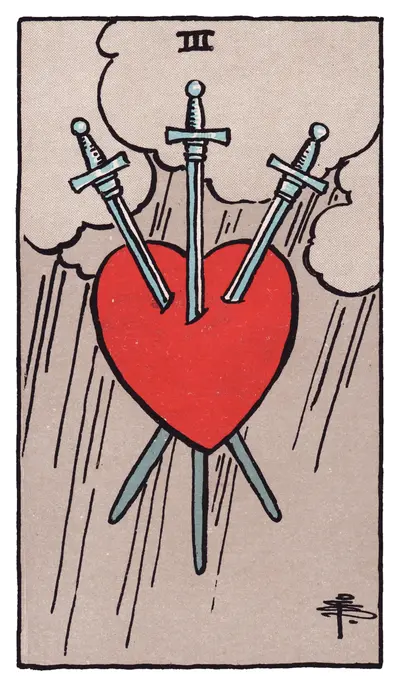
Sorrow, and Book T uses the plainest available word. Not loss, not grief, not betrayal — sorrow, which is the feeling rather than the event. Placed in the second decan of Libra, the sign of partnership, it is the middle of the most relational sign in the zodiac, and the title’s bluntness fits the image: a heart with three swords through it and rain behind, with no figure, no setting and no story. The card is the feeling, unattached to a cause.
Upright meaning
Three swords pierce a heart against a grey sky and falling rain. It is the most abstract image in the Minor Arcana — the only card with no person, no landscape and no object other than the emblem itself — and that abstraction is the reason it works. There is nothing to interpret. Everybody who draws it knows what it means before any reading begins. What the Three of Swords describes is pain that has already happened and is fully known: not a warning, not a risk, but a hurt that is present and identified. The three swords are usually read as the mind’s part in it, which is the suit’s territory — this is the card of understanding exactly what went wrong, which is why it hurts precisely rather than diffusely. Three in the pips is where a pair becomes a situation, and in air the situation is that something has been said, or understood, or admitted, and cannot be unsaid. It is a hard card and it is not a hopeless one. Nothing in it is ongoing.
Reversed meaning
Reversed, the sorrow changes state rather than disappearing. The commonest reading is recovery — the swords coming out, the rain clearing — which is favourable and usually accurate, since the upright card describes something already complete. A second reading concerns the hurt being held rather than felt: pain that has been put away without being finished, which tends to surface later and is worth naming carefully. A third is about the telling rather than the feeling, where reversed the card describes something painful that has not been said out loud. Where the surrounding cards are moving the first reading applies; where they are static, the second.
What Saturn in Libra contributes
Saturn in Libra is exaltation — Saturn is at its strongest in the sign of balance — and it is the reason this card is so clean. Saturn brings the truth of a matter into view and does not soften it; Libra insists on the fair account. What the pairing produces is sorrow that is accurate, which is both why the card hurts so specifically and why it is ultimately survivable. There is nothing distorted here and nothing exaggerated. That also explains the card’s abstraction: Saturn in exaltation does not need a scene, only the fact.
What is on the card
The heart is a single flat emblem rather than a body, which places the card outside any particular story. The three swords enter at even angles and pass entirely through, so nothing is lodged. The rain is drawn as separate strokes against grey cloud that fills the whole background with no horizon and no ground. There is no light source. The absence of a figure is the most deliberate choice in the image: nobody is depicted feeling this, which means anybody can be.
In a love reading
Heartbreak, and the card is not evasive about it. It describes a specific hurt rather than an atmosphere, and frequently one involving something said. It is among the clearest cards in the deck on questions about whether something has gone wrong. On questions about recovery it is silent, since the card depicts a moment and not a trajectory — that reading has to come from its neighbours. Where a relationship is continuing, it frequently marks the point at which something was said that cannot be taken back, which is a more precise reading than heartbreak and often the more useful one. The card does not distinguish between a hurt that ends things and one that is absorbed.
In a career reading
Disappointment that is precise: a decision explained, a rejection with reasons attached, a criticism that landed because it was accurate. Saturn in Libra makes this the card of the fair judgement that hurts, which is a real and particular professional experience. On questions about workplace conflict it indicates something already said rather than brewing. It is also the card of the accurate performance review, which is an experience with almost no other representation in the deck. Saturn in Libra will not let the judgement be dismissed as unfair, and that is exactly why it lands — a criticism that could be rejected would not produce this card.
How this one is usually misread
The frequent error is reading this as betrayal, which is one cause among many and gets treated as the meaning. The image contains no second party at all — no figure, no hand, no relationship — and a reader who supplies a betrayer has invented one. Sorrow has many sources and the card names none of them. The second misreading is forward-looking: taking the Three of Swords as a warning of heartbreak to come. It depicts something that has happened, which is why the swords are already through rather than approaching, and delivering it as a prediction turns a description of a known pain into a fear of an unknown one. That is a materially worse thing to hand someone.
How it behaves beside other cards
With the Two of Cups it usually dates a rupture rather than describing one, and the pair is among the most legible in the deck. Beside the Tower the sorrow has a specific event behind it. With the Star it becomes recovery already under way, one of the deck’s kinder pairings. Next to the Four of Swords the card turns from pain into the rest that follows it. Its most illuminating neighbour is the Ace of Swords, which identifies the thing that was said or understood — the Three shows the wound and the Ace shows the blade. With the Page of Swords the words that caused it were probably careless rather than aimed. Beside the Queen of Swords the sorrow has been understood and is being carried without complaint, which is that figure’s whole posture. Next to the Six of Cups the hurt is old and is being revisited rather than sustained. The Knight of Cups arriving afterwards is one of the deck’s gentler sequels.
Why this card has a zodiac sign attached
The thirty-six numbered cards from Two to Ten are mapped one-to-one onto the thirty-six decans — the ten-degree slices the zodiac divides into. Three of Swords holds 190° to 200° of Libra, ruled by Saturn in the Chaldean order. That is a lookup from a position on the ecliptic, not an association someone chose, which is why this page can print a degree range and a date range next to it.
Correspondences follow the Golden Dawn attributions set out in Book T. Degrees are computed from each card’s position in the decan sequence rather than transcribed, so they cannot drift from the spread tool on the rest of this site.
Cards next to this one
The rest of Libra
See this card come up in your own chart
The spread on our tarot astrology page reads your chart positions as cards — no shuffle, the same answer every time. The daily card does the same for the Moon’s decan right now.