Minor Arcana · Cups · water
Five of Cups
Dates are for 2026 and shift by up to a day between years, because the tropical year is not a whole number of days.
The Book T title
Loss in Pleasure is a title built out of a contradiction, and the contradiction is the card. It names loss located inside something that was a source of enjoyment — not misfortune arriving from outside but the failure of a thing that was good. Placed in the first decan of Scorpio, it opens the sign most associated with what cannot be undone, and the title is accordingly specific: Book T is not describing sadness in general but the particular grief that attaches to something you chose and wanted.
Upright meaning
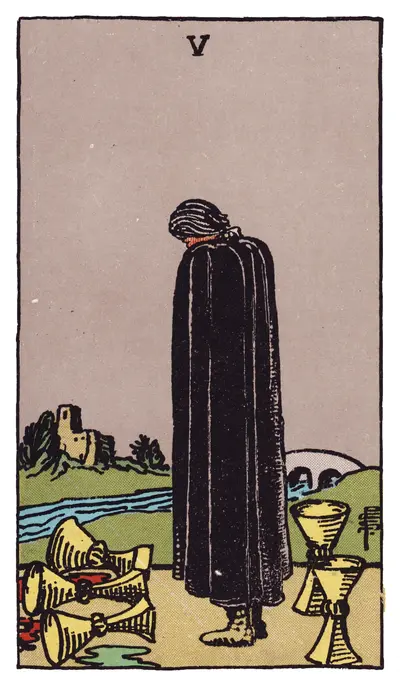
A cloaked figure stands looking down at three spilled cups. Behind him, unregarded, two cups remain upright. Across the river there is a bridge and a house. The card is almost cruelly well designed, because everything needed to move on is in the frame and none of it is being looked at. What it describes is grief that is legitimate and also partial — the loss is real, the three cups genuinely went over, and the proportion is wrong. When it arrives, the thing being asked about involves a loss that has already happened, and the card’s contribution is not consolation but arithmetic: the count is five, not three. This is worth handling carefully in a reading, because saying "look at what you still have" to someone in this position is both what the card says and the least useful way to say it. The figure will turn around when he turns around. Five in the pips is the number where a stable four breaks, and in water it breaks into mourning rather than conflict.
Reversed meaning
Reversed, the figure turns. The commonest reading is recovery beginning — the two standing cups being noticed, which the upright card makes so available that its reversal is unusually reliable. A second reading concerns forgiveness, of another person or of oneself, and it arrives more often in this card than in any other in the suit. The harder version is grief that has been packed away rather than worked through, where the turning is premature and the cloak has simply been pulled tighter. Where the surrounding cards are difficult that reading is worth considering, but the favourable one is the more common and should usually be offered first.
What Mars in Scorpio contributes
Mars in Scorpio is the planet of force in the sign it traditionally rules, which is another undiluted placement — and in water it produces something very unlike the Wands equivalent. Mars here does not act outward; Scorpio turns it inward, and the result is intensity with no exit. That is exactly the emotional shape of this card: the grief is not passive, it is active and effortful, which is why the figure is standing rather than sitting and why the posture reads as concentration rather than collapse. It also explains the card’s duration. Mars does not tire quickly, and mourning under this decan is characteristically longer than the circumstances would predict.
What is on the card
Three cups lie spilled and two stand, and the two are behind him — the composition puts the remainder out of his sightline rather than merely out of his attention. His cloak is black and entirely covers him, the only figure in the suit so concealed. The river between him and the bridge is narrow and easily crossed; the bridge is intact and the house on the far side is lit. Nothing in the landscape prevents departure. The spilled cups have stained the ground, which is the one detail confirming the loss is real rather than imagined.
In a love reading
Grief over a relationship, most often one that has ended, and the card is unusually honest about the stage: this is during rather than after. It also appears when a relationship is being mourned while still continuing, which is a specific and often unspoken situation. On questions about whether to reconcile it is not an answer but a description — the querent is looking at what went wrong and has not yet looked at what remains.
In a career reading
A loss at work that is being dwelt on: a role not got, a project cancelled, a decision that went badly. Its usable contribution is the two standing cups, which in professional questions usually correspond to something concrete that survived and has not been counted. On questions about recovering from a setback it is encouraging in a slightly severe way — the recovery is available and nobody is going to hand it over.
How this one is usually misread
The frequent error is reading this as total loss, which the image explicitly contradicts: two cups are standing and the bridge is intact. A reading that takes the card as ruin has looked only where the figure is looking, which is the mistake the card is depicting rather than the one it is making. The second and more delicate error runs the other way. Because the two remaining cups are so visible to the reader, it is tempting to deliver the card as an instruction to cheer up, and that is both what it says and the least useful way to say it. The grief in this card is legitimate; the proportion is what is off. Saying so without dismissing the loss is the actual skill the Five of Cups asks for.
How it behaves beside other cards
With the Three of Swords the loss acquires a specific injury and usually a specific person. Beside the Six of Cups it turns toward memory, and the pair together often describe someone living in a version of the past. With the Star it becomes recovery unambiguously, and that combination is one of the most straightforwardly hopeful in the deck. Next to the Two of Cups the standing cups are identified: the remaining relationship is the thing not being looked at. Its most uncomfortable neighbour is the Four of Cups, where the flatness that preceded the loss becomes part of the story. With the Knight of Cups someone is approaching who has not been noticed, which is the two standing cups arriving in person. Beside the Ace of Cups the grief is genuinely finished, and the card becomes a description of where the querent has been rather than where they are. With the Six of Pentacles help is offered and the figure has not turned round far enough to see it being held out. Beside the Page of Cups an offer of comfort arrives from someone younger or newer than the loss.
Why this card has a zodiac sign attached
The thirty-six numbered cards from Two to Ten are mapped one-to-one onto the thirty-six decans — the ten-degree slices the zodiac divides into. Five of Cups holds 210° to 220° of Scorpio, ruled by Mars in the Chaldean order. That is a lookup from a position on the ecliptic, not an association someone chose, which is why this page can print a degree range and a date range next to it.
Correspondences follow the Golden Dawn attributions set out in Book T. Degrees are computed from each card’s position in the decan sequence rather than transcribed, so they cannot drift from the spread tool on the rest of this site.
Cards next to this one
The rest of Scorpio
See this card come up in your own chart
The spread on our tarot astrology page reads your chart positions as cards — no shuffle, the same answer every time. The daily card does the same for the Moon’s decan right now.