Minor Arcana · Swords · air
Five of Swords
Dates are for 2026 and shift by up to a day between years, because the tropical year is not a whole number of days.
The Book T title
Defeat, and Book T assigns it to the winner. That inversion is the card. The figure holding the swords is the one who prevailed, and the title given to his card is Defeat — which tells you the Golden Dawn read the victory as the loss. Placed in the first decan of Aquarius, the sign of principle and of the collective, it opens the sign with somebody who has won something at the cost of everyone around him, and the placement makes that cost specifically social.
Upright meaning
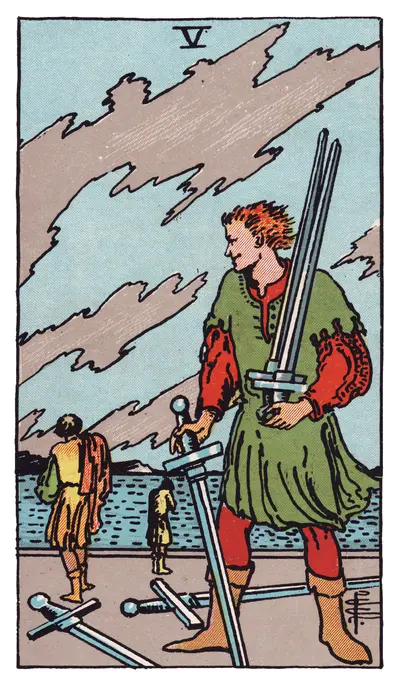
A man gathers swords with a look on his face that every reader recognises and few enjoy, while two figures walk away toward the shore with their backs turned. He has three swords; two more lie on the ground. Nothing about the outcome is in doubt and nothing about it is satisfying. The Five of Swords is the card of winning badly — an argument won by being unpleasant, a point scored that cost the relationship, a victory nobody is going to congratulate. What makes it unusually useful is that it works from either side. The querent may be the man with the swords or one of the figures leaving, and the surrounding cards will usually say which, though the card itself refuses to. Five in the pips is where stability breaks, and in air it breaks into conflict that is conducted with words and leaves the field emptier than it found it. There is no ambiguity about who won. The question the card raises is whether that was the thing worth having.
Reversed meaning
Reversed, the aftermath comes into focus. The commonest reading is reconciliation or the wish for it — the recognition that the win was not worth its price, which is the natural sequel to the upright card. A second is the opposite: a conflict that has not finished, where the walking-away is temporary and the matter will return. A third concerns the querent stepping out of a fight they could win, which is favourable and is one of the few readings in this suit that describes a genuinely good decision. Where the surrounding cards are soft, the first; where they are sharp, the second.
What Venus in Aquarius contributes
Venus in Aquarius is the planet of connection in the sign of principle, and it accounts for the card’s particular coldness. Aquarius will sacrifice a relationship to be right, and Venus in that sign is affection subordinated to a position. The pairing does not produce cruelty exactly — nothing here is sadistic — but it does produce someone for whom being correct outranks being close, which is precisely the expression on the figure’s face. It also explains why the two who leave are leaving together. Aquarius is the sign of the group, and what the winner has lost is the group.
What is on the card
He holds three swords and two lie at his feet, so he has not even picked up all of them — the collecting is unfinished and possibly pointless. His expression is the most legible in the deck and is the card’s single most quoted element. The two departing figures are drawn small, backs turned, heads down, walking toward water. The sky is torn with ragged cloud in a pattern that appears nowhere else in the suit. The ground is bare and rising, and he is standing on the high point of it, alone.
In a love reading
An argument won at cost, or a relationship in which being right has become the objective. It is one of the clearest cards for questions about recurring conflict, and its contribution is the two figures leaving — somebody is withdrawing, and the card indicates it before the querent has usually noticed. On questions about reconciliation it is discouraging while the swords are still being gathered. The card is also useful on questions where the querent is not the one holding the swords, since it describes the experience of the departing figures as clearly as the winner’s — being on the losing side of an argument conducted by somebody who needed to win it. Which position applies is usually obvious from the question rather than the card.
In a career reading
Office conflict with a clear winner and a damaged team. It appears often in questions about a colleague who has prevailed in a way that has cost them standing, and equally often when the querent is that person. On questions about whether to escalate it is a caution rather than a prohibition: the card says you will probably win and describes the room afterwards. It also covers the specific situation of a workplace where somebody has been proved right in a way that has cost them, which is a common and rarely named dynamic. On questions about reputation it is a caution: the win is real and the account of it circulating among colleagues is being written by the people who walked away.
How this one is usually misread
The frequent error is reading this as defeat for the querent, which the title invites and the image contradicts — the man in the foreground has the swords. Book T calls the card Defeat because it regards his victory as the loss, and a reading that assigns the defeat to the figures walking away has inverted the card’s actual argument. The second misreading is moralising. The card describes a cost and does not condemn anyone; some conflicts genuinely are worth winning this way, and a reading that tells the querent they were wrong to win has supplied a judgement the Golden Dawn made about the situation, not about them.
How it behaves beside other cards
With the Three of Swords the words that were used become the subject. Beside the Six of Swords the leaving in the background becomes the main event, and the pair describes an exit following a fight. With the Justice card the conflict acquires a legitimate resolution the Five cannot reach on its own. Next to the Four of Cups the winner is already flat about it. Its most revealing neighbour is the Two of Cups, which identifies exactly what has been spent to win. Beside the Ten of Swords the conflict has gone past winning into something nobody gains from. With the Temperance card the fight is resolved by proportion rather than by victory, which is the outcome the Five cannot reach alone. Next to the Page of Cups somebody younger in the situation is taking it much harder than the winner assumes.
Why this card has a zodiac sign attached
The thirty-six numbered cards from Two to Ten are mapped one-to-one onto the thirty-six decans — the ten-degree slices the zodiac divides into. Five of Swords holds 300° to 310° of Aquarius, ruled by Venus in the Chaldean order. That is a lookup from a position on the ecliptic, not an association someone chose, which is why this page can print a degree range and a date range next to it.
Correspondences follow the Golden Dawn attributions set out in Book T. Degrees are computed from each card’s position in the decan sequence rather than transcribed, so they cannot drift from the spread tool on the rest of this site.
Cards next to this one
The rest of Aquarius
See this card come up in your own chart
The spread on our tarot astrology page reads your chart positions as cards — no shuffle, the same answer every time. The daily card does the same for the Moon’s decan right now.