Minor Arcana · Swords · air
Seven of Swords
Dates are for 2026 and shift by up to a day between years, because the tropical year is not a whole number of days.
The Book T title
Unstable Effort names something narrower than theft, and the difference matters because this card is almost always read as deception. Book T is describing an approach that will not hold — effort applied in a way that cannot be sustained, whether or not anybody is being cheated. Placed in the third decan of Aquarius, closing the sign, it is the point where detachment becomes evasion, and the instability is built into the method rather than into the intention.
Upright meaning
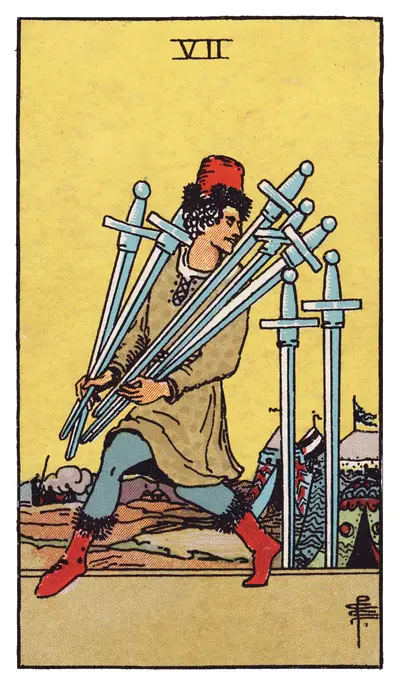
A man creeps away from a camp carrying five swords, leaving two standing behind him, looking back over his shoulder with what can only be described as a grin. In the distance a group of figures stands by tents, unaware. It is the deck’s card of getting away with something, and the two swords left behind are the most important detail in it: whatever he is taking, he has not taken all of it and will have to come back or do without. That is the instability the title names. The card covers deception, certainly, but it covers a wider and more useful range than that — working around a system rather than through it, solving something by a route that will not scale, avoiding a confrontation by stealth rather than by resolution. Seven in the pips is where a settled six meets pressure, and in air the pressure produces cleverness. Nothing in the card fails. Everything in it is provisional.
Reversed meaning
Reversed, the getting-away-with-it stops. The commonest reading is exposure — the return, the confession, the thing coming to light — which is the natural resolution of the upright position. A second is the querent choosing not to take the route, declining the shortcut, which is favourable and under-offered. A third concerns being on the other side of it: something taken from the querent, or a suspicion confirmed. Where the surrounding cards show other people, the third reading is worth weighing; where the reading is about the querent’s own choices, the second.
What Moon in Aquarius contributes
The Moon in Aquarius is feeling in the sign of detachment, and it produces the card’s particular emotional temperature — which is not guilt. The Moon supplies the instinct and Aquarius supplies the distance from consequence, so the figure is not agonising. He is calculating, and enjoying it. That combination is also why the effort is unstable: the Moon does not sustain a fixed course and Aquarius does not defer to the arrangement being circumvented. Nothing in this decan builds anything that will still be standing later.
What is on the card
Five swords are carried by the blades, which is both awkward and revealing — he is holding them in the way that most risks cutting himself. Two remain planted upright in the ground behind him. His posture is mid-tiptoe and his head is turned back rather than forward. The camp in the distance has tents and figures and a flag, all rendered small and oblivious. The ground is flat and open, with no cover anywhere, which makes the stealth look considerably less viable than his expression suggests.
In a love reading
Something not being said, which covers a wide range from a small concealment to genuine dishonesty. It is worth reading at the milder end unless the surrounding cards insist otherwise, since the card’s subject is an unsustainable approach rather than a betrayal. It can also describe a relationship being conducted around an obstacle rather than through it. It is also the card of the small undisclosed thing rather than the large one, which is worth saying because it is so often delivered as infidelity. A separate account, an unmentioned conversation, a plan being made quietly — these fit the image far better than a secret life, and the two swords left behind suggest something unfinished rather than something concealed at scale.
In a career reading
Workarounds, shortcuts and information being handled selectively. It appears frequently in questions about a colleague and about competitive situations. On questions about strategy its contribution is the two swords left behind: the plan is incomplete, and the part being skipped is the part that will require a return. It also describes taking credit at the edges of what is defensible, and the card is notably neutral about whether that is justified. On questions about whether something will be noticed, the open ground in the image is the answer: there is no cover anywhere, and the figure’s confidence is not supported by his surroundings.
How this one is usually misread
The standard error is reading this as theft or betrayal full stop, which narrows a card about unsustainable method into a card about a bad person. The title is Unstable Effort, not Deceit, and the range it covers includes entirely honest shortcuts that simply will not hold. Delivering it as "someone is lying to you" produces suspicion the card may not warrant. The second misreading concerns the two swords left behind: they are routinely treated as decoration when they are the card’s actual argument. The job is not finished. Whatever has been got away with will require a return, and that is the practical thing the Seven of Swords is telling anybody who draws it.
How it behaves beside other cards
With the Three of Cups the deception acquires a social setting, and that pairing supports a betrayal reading far better than either card alone. Beside the Moon almost nothing in the situation can be taken at face value. With the Justice card the return happens and is not on the querent’s terms. Next to the Eight of Pentacles the shortcut is contrasted with the patient method and usually loses. Its most useful neighbour is the Ace of Swords, which cuts through the whole arrangement and generally means the matter will be settled plainly. Beside the Hermit the withdrawal is honest rather than evasive and the swords are simply being carried away from a fight nobody needed. With the High Priestess the concealment is discretion rather than deception, which is the most generous reading available. Next to the Ten of Pentacles the shortcut is being taken around something that took other people a very long time to build, which tends to settle the question of whether it is worth it. With the Knight of Wands the scheme acquires a partner who will not be careful, which is the combination most likely to expose it. Beside the Moon almost nothing in the arrangement can be verified, including by the person making it.
Why this card has a zodiac sign attached
The thirty-six numbered cards from Two to Ten are mapped one-to-one onto the thirty-six decans — the ten-degree slices the zodiac divides into. Seven of Swords holds 320° to 330° of Aquarius, ruled by Moon in the Chaldean order. That is a lookup from a position on the ecliptic, not an association someone chose, which is why this page can print a degree range and a date range next to it.
Correspondences follow the Golden Dawn attributions set out in Book T. Degrees are computed from each card’s position in the decan sequence rather than transcribed, so they cannot drift from the spread tool on the rest of this site.
Cards next to this one
The rest of Aquarius
See this card come up in your own chart
The spread on our tarot astrology page reads your chart positions as cards — no shuffle, the same answer every time. The daily card does the same for the Moon’s decan right now.