Minor Arcana · Pentacles · earth
Six of Pentacles
Dates are for 2026 and shift by up to a day between years, because the tropical year is not a whole number of days.
The Book T title
Material Success sits oddly on a card showing charity, and the oddness is the most informative thing about it. Book T assigns the success to the man with the scales — the giving is evidence that he has enough to give. Placed in the second decan of Taurus, the middle of the sign of resources, it describes wealth in circulation rather than at rest, which is what distinguishes it from the Four. The title is about the donor, and every complication in the card follows from that.
Upright meaning
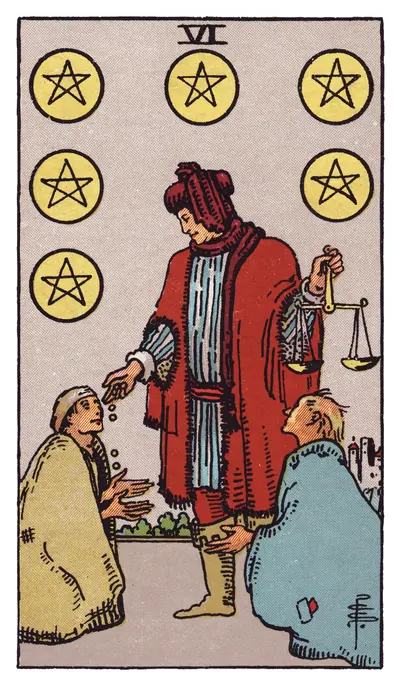
A merchant in red holds a pair of scales in one hand and drops coins into the hands of a kneeling beggar with the other, while a second kneels beside him. The card is universally read as generosity, and it is, with a structure worth noticing: the scales are in the image, the giver is standing, and the recipients are on the ground. This is help that is being measured and is flowing in one direction. When it arrives, the thing being asked about involves resources moving between people who are not in the same position, which covers charity, patronage, a loan, a favour, or any support with an implicit ledger behind it. Six in the pips is exchange and return, and in earth the exchange is unequal by definition, because one party has and the other does not. None of this makes the card unkind. The help in it is genuine and the recipients are genuinely helped.
Reversed meaning
Reversed, the imbalance becomes the subject. The commonest reading is generosity with strings, where the scales turn out to be a record rather than a measure. A second is the reverse position: being on the receiving end and finding the terms uncomfortable, which is under-offered and frequently accurate. A third concerns the help stopping, either withdrawn or no longer needed, and the surrounding cards separate those cleanly. Where a reading involves debt in any form the reversal is worth weighing carefully, since the upright card already contains the ledger.
What Moon in Taurus contributes
The Moon in Taurus is exaltation — the Moon is at its most comfortable in the sign of the body — and it is why this card is warm rather than transactional. The Moon supplies the care, Taurus supplies the actual resources, and the pairing produces giving that is felt rather than merely correct. It also explains the scales. Exalted Moon is generous and it is not indiscriminate; Taurus does not hand things over without knowing what it is handing over. The combination is the most materially comfortable decan in the deck, which is precisely why the man in the image can afford the gesture.
What is on the card
The scales are held level and empty, which is the detail readers most often miss — nothing is being weighed in them, so they are a statement about the giver rather than a measurement of the gift. The coins fall from his other hand into one beggar’s cupped palms while the second kneels empty-handed and unattended. He is dressed in red and stands; both recipients kneel. Two towers rise behind him in the distance. The ground is bare and there is no building nearby, so the transaction is happening in the open with no institution behind it.
In a love reading
A relationship with an imbalance in it that is currently working — one person giving more, materially or emotionally, and both parties comfortable with the arrangement. It frequently appears in questions about a partnership where one person supports the other through something, which is a real and honourable situation the deck otherwise has few cards for. On questions about whether support is genuine it is favourable. On questions about equality it is honest: the card shows somebody standing and somebody kneeling, and that is the arrangement rather than a distortion of it.
In a career reading
Mentorship, patronage, funding, a raise, a favour from someone senior. It is one of the better cards for questions about whether help will come, and it is specific that the help arrives from someone with more rather than from a peer. On questions about salary it is favourable and quietly notes that the amount is being decided by somebody else. It also covers the querent as the giver — managing a budget, hiring, distributing work — where the scales become the relevant detail and the second, unattended beggar becomes the question worth asking about.
How this one is usually misread
The common error is reading this as pure generosity and stopping, which misses that Book T calls it Material Success and assigns it to the donor. The card is as much about having enough to give as about giving, and its structure — one standing, two kneeling, scales in hand — is not a picture of equality. The second misreading is the cynical overcorrection, treating the scales as proof that the giving is calculated or conditional. They are empty and level. The honest reading sits between the two: this is real help, delivered from a position of advantage, with the ledger visible and not yet being used.
How it behaves beside other cards
With the Five of Pentacles it is the direct resolution and one of the deck’s clearest two-card sequences. Beside the Four of Pentacles the contrast between holding and circulating is the whole reading. With the Devil the strings become explicit. Next to the Justice card the scales stop being decorative and the arrangement is examined on its merits. Its most uncomfortable neighbour is the Ten of Wands, where the giving turns out to be one more thing the querent is carrying. Beside the Emperor the giving comes with authority and the terms are not negotiable. With the Knight of Pentacles the help is reliable and slow rather than generous and sudden. Next to the Seven of Pentacles the support buys time rather than solving anything, which is frequently what support actually does. Next to the Two of Pentacles the giving is one more thing being balanced. With the Ten of Cups the help is family rather than patronage, which removes the ledger entirely and is the kindest version of this card. Beside the Page of Swords somebody is watching the transaction and drawing conclusions. Beside the Hermit the giver is more solitary than the scene suggests, and the transaction is the only contact. With the Wheel of Fortune the positions of giver and receiver are not permanent, which both parties usually forget.
Why this card has a zodiac sign attached
The thirty-six numbered cards from Two to Ten are mapped one-to-one onto the thirty-six decans — the ten-degree slices the zodiac divides into. Six of Pentacles holds 40° to 50° of Taurus, ruled by Moon in the Chaldean order. That is a lookup from a position on the ecliptic, not an association someone chose, which is why this page can print a degree range and a date range next to it.
Correspondences follow the Golden Dawn attributions set out in Book T. Degrees are computed from each card’s position in the decan sequence rather than transcribed, so they cannot drift from the spread tool on the rest of this site.
Cards next to this one
The rest of Taurus
See this card come up in your own chart
The spread on our tarot astrology page reads your chart positions as cards — no shuffle, the same answer every time. The daily card does the same for the Moon’s decan right now.