Minor Arcana · Cups · water
Six of Cups
Dates are for 2026 and shift by up to a day between years, because the tropical year is not a whole number of days.
The Book T title
Pleasure, unqualified, and it is the counterpart to the Two of Cups as the only other Minor title naming a feeling outright. Book T places it in the second decan of Scorpio, which surprises people who know the card as sweet and nostalgic — the sign of depth and of what does not let go. That placement is the key to the card. The pleasure named here is not present enjoyment but the kind that is retained, which is why the imagery is about memory and why the card can turn melancholy without changing a single element.
Upright meaning
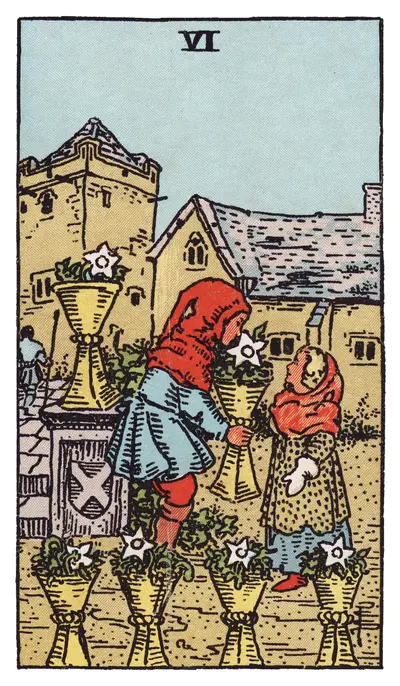
A child hands a cup filled with white flowers to a smaller child in a walled courtyard, while a guard walks away in the background. Everything is gentle and everything is past. The Six of Cups is the deck’s memory card, and what it describes specifically is the present being coloured by something earlier — a kindness returned, a person reappearing, a pattern from childhood showing up intact in adult life. It is warm and it is not simple, because the warmth is directed backwards. When it arrives, the thing being asked about has a history attached, and the history is doing more work than the current circumstances. That reading covers the pleasant version, where an old connection resurfaces, and the less pleasant one, where a present situation is being lived through an old template. Six in the pips is the number of return and exchange, and in water it returns feeling rather than favour.
Reversed meaning
Reversed, the direction of attention is what changes. The commonest reading is the past losing its hold — nostalgia lifting, an old pattern being seen as a pattern, which is favourable and frequently arrives as relief rather than triumph. The second reading is the opposite: being stuck in the memory to the exclusion of the present, which the upright card is always adjacent to. A third concerns the people in it, where a figure from the past is genuinely returning rather than merely being remembered. Where the surrounding cards involve movement the first reading is usually right; where they involve stillness, the second.
What Sun in Scorpio contributes
The Sun in Scorpio is a placement of concentrated rather than broadcast light, and it gives this card its particular quality: warmth that is specific and slightly enclosed. The Sun supplies the genuine pleasure the title names, and Scorpio supplies the retention — nothing under this decan is released casually. That combination is why the Six of Cups feels both lovely and faintly airless, and why the courtyard in the image is walled. It also explains why memory is the subject rather than simple enjoyment. Scorpio does not let a good thing pass and be gone; it keeps it, and a kept pleasure is by definition a remembered one.
What is on the card
The cups hold white flowers rather than liquid, which is the detail that converts them from vessels into keepsakes — nothing here is being drunk. Five stand about the courtyard and one is being handed over, so the exchange is a single gesture inside an existing arrangement. The two figures are children, and the larger stoops to the smaller, which is the only openly tender posture in the Minor Arcana. A guard in the background is walking out of the frame, leaving them unsupervised. The buildings are solid and old, and the whole scene is enclosed by walls on every visible side.
In a love reading
Frequently indicates someone from the past — an ex, a first love, a reconnection — and it is one of the cards most often read too literally in that direction. Where it is not a person it describes a relationship being lived in a familiar register, comfortable and slightly retrospective. On questions about whether an old relationship can resume it is encouraging about the feeling and silent about whether it should, which is a distinction worth preserving in the reading.
In a career reading
Old contacts, previous employers, skills from an earlier stage becoming relevant again. It is a favourable card on questions about returning to something, and a cautionary one on questions about innovation, since nothing in it is new. On questions about workplace relationships it usually points at a long-standing one that is easy in a way newer ones are not. It is also the card most likely to indicate that the right move is one you have made before — a former employer, a shelved craft, a market you used to know — which is unfashionable advice and frequently the correct advice.
How this one is usually misread
The usual error is treating this as an ex-partner card, full stop. It can indicate one, and the tradition supports that reading, but the card’s actual subject is the past acting on the present in any form — a habit, a template, a kindness, a place. Delivered as "someone is coming back" in a question about work or family, it has been narrowed to a fraction of itself. The second misreading is the sweetness. The imagery is the most tender in the suit and the decan is the Sun in Scorpio, which is anything but uncomplicated; readers who stop at charm miss that this card is entirely capable of describing someone living inside a memory rather than visiting one. The walls around the courtyard are doing real work in the image.
How it behaves beside other cards
With the Five of Cups the memory is of something lost and the pair usually describes dwelling. Beside the Eight of Cups it reverses into leaving the past rather than returning to it, which is one of the sharper contradictions two adjacent cards can produce. With the Ten of Cups the nostalgia turns into a present family rather than a remembered one. Its most useful neighbour is the Knight of Cups, which converts memory into approach: someone is not just being remembered but arriving. Next to the Devil the pattern from the past becomes one the querent is choosing to repeat. With the Page of Pentacles the past becomes a skill being picked up again rather than a person returning. Beside the Tower the memory is of something that ended abruptly, and the sweetness in the card turns into the specific ache of remembering a life before an event. With the Three of Cups the memory becomes a group of people rather than a single person, and usually a period rather than an event.
Why this card has a zodiac sign attached
The thirty-six numbered cards from Two to Ten are mapped one-to-one onto the thirty-six decans — the ten-degree slices the zodiac divides into. Six of Cups holds 220° to 230° of Scorpio, ruled by Sun in the Chaldean order. That is a lookup from a position on the ecliptic, not an association someone chose, which is why this page can print a degree range and a date range next to it.
Correspondences follow the Golden Dawn attributions set out in Book T. Degrees are computed from each card’s position in the decan sequence rather than transcribed, so they cannot drift from the spread tool on the rest of this site.
Cards next to this one
The rest of Scorpio
See this card come up in your own chart
The spread on our tarot astrology page reads your chart positions as cards — no shuffle, the same answer every time. The daily card does the same for the Moon’s decan right now.