Minor Arcana · Cups · water
Ace of Cups
The Book T title
The Root of the Powers of Water, and the title is doing something specific: water in the Golden Dawn scheme is feeling, and the root of feeling is not any particular emotion but the capacity to be moved at all. That is why the Ace of Cups is not simply a love card. It has no decan and no degrees, because a root is not located anywhere — it is what the thirty-six degrees of water in the other Cups cards are drawing from.
Upright meaning
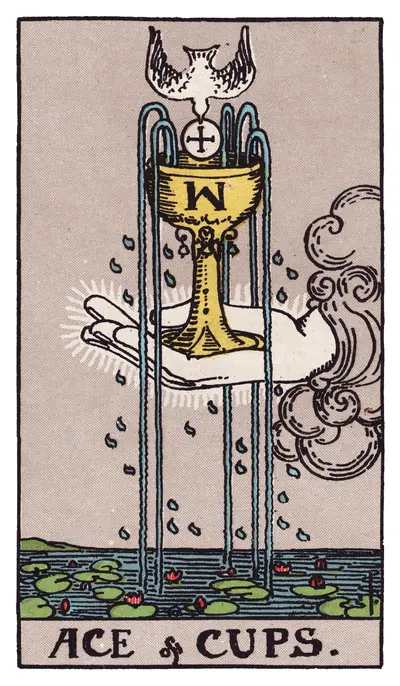
A hand offers a cup from which five streams pour, a dove descends toward it carrying a wafer, and water lilies float on the surface below. The cup is overflowing before anybody has touched it. The Ace of Cups is emotional opening — the capacity to feel something arriving, rather than a particular feeling — and its distinguishing feature is abundance without a recipient. Nothing in the image indicates who this is for. When it arrives, something has become emotionally available: a person, a reconciliation, a feeling that was not accessible last month. It is among the most favourable cards in the deck and it is not a promise about anybody. The card describes a condition rather than an event, which is why readings that convert it into a specific relationship are supplying the specificity themselves. The four Aces share a grammar that no other cards in the deck use: a hand from a cloud, one emblem, and no figure at all. Nobody has taken anything on any of them, which is the tradition saying structurally that an Ace describes an availability rather than an event. This one is the only Ace whose emblem is already active before anyone touches it — the cup is overflowing, the dove is descending, five streams are running — so where the other three wait to be accepted, the Ace of Cups is spilling regardless. That is the most accurate thing the image says about feeling: it arrives whether or not there is anywhere to put it.
Reversed meaning
Reversed, the cup empties or is refused. The commonest reading is emotional blockage — the feeling present and not accessible, which people usually recognise immediately. A second is the offer not taken: something available and declined, sometimes for good reasons the card does not judge. A third and gentler reading is emotion turned inward rather than absent, which is a real state and frequently mistaken for the first. Reversed Aces of Cups are seldom cold; the water is still there and is not reaching anything.
The root of Water
Water is the element of feeling and of what connects one thing to another, and the Ace is that capacity before it has attached itself to a subject. That is why five streams pour from a single cup — the overflow has no direction, it simply exceeds the vessel. In the Golden Dawn scheme the Ace rules a quadrant of the heavens rather than a sign, which is the structural reason it cannot be drawn from a chart position: a placement is somewhere, and the root of water is wherever water is.
What is on the card
Five streams pour from a cup with five sides, and the number five is unexplained anywhere in the tradition — it is usually read as the five senses, which is a guess with a long history. The dove descends carrying a disc marked with a cross, the eucharistic wafer, which makes this the most overtly Christian image in the Minor Arcana. Twenty-six drops of water fall around the cup in a regular pattern. Below, water lilies rest on a still lake. The letter W appears inverted on the cup’s face, which readers have argued about for a century without resolution.
In a love reading
The strongest opening card in the deck for a relationship question, and reliably favourable. It describes the beginning of feeling rather than the establishment of a relationship, which is a distinction worth preserving — the Two of Cups is the card where a second person appears. On questions about whether someone feels something it is a clear yes. On questions about what will come of it, the card is genuinely silent, and a reading that fills that silence is guessing. It also appears where an existing relationship becomes emotionally available again after a closed period.
In a career reading
Less directly applicable than the other Aces and most useful on questions about work that involves people or feeling — care, teaching, creative work, anything where the quality of the relationship is the product. On ordinary advancement questions it is weak, because nothing in it concerns achievement. Where it does appear on a work question it usually indicates that the right move is the one the querent actually wants rather than the one that looks correct, which is unfashionable advice and often the accurate reading of this card.
How this one is usually misread
The common error is reading this as a specific person arriving, which is the single most frequent over-reading in the deck. The cup is offered to nobody in the image; there is no second figure anywhere in the frame. Delivered as "someone is coming", it converts a card about capacity into a prediction about a stranger. The second misreading is treating it as interchangeable with the Two of Cups. The Ace is one hand and one cup; the Two is two people and an exchange, and the difference between having something to give and having someone to give it to is the whole distance between the two cards. A third habit worth breaking is treating the Ace as the strongest card in a love reading. It is the most favourable opening, which is not the same thing: the Two, the Ten and the Four of Wands all describe something further along, and a spread in which the Ace is the only Cups card is describing a capacity rather than a relationship.
How it behaves beside other cards
With the Two of Cups the feeling finds its second party. Beside the Three of Swords it is recovery rather than beginning, and the pair is one of the kinder sequences available. With the Four of Cups the overflowing vessel is precisely the cup being ignored. Next to the Nine of Pentacles something is being offered that a carefully built solitude has no room for. Its most complete neighbour is the Ten of Cups, where the root has produced the whole tree. Beside the Page of Cups the feeling arrives with somebody unguarded enough to say so. With the Five of Cups it is the reason the figure eventually turns round. Next to the Eight of Cups something is being offered exactly as the querent is leaving, which is among the harder timings the deck depicts and a very common one. Next to the Hermit the capacity is present and is deliberately not being used, which is a real and defensible position the card does not argue with.
Why this card has no degrees
The four Aces are the root of their element rather than a place in the zodiac. Ace of Cups is the root of Water. A card with no span cannot be drawn from a chart position, which is exactly why the spread tool never returns one.
Correspondences follow the Golden Dawn attributions set out in Book T. Degrees are computed from each card’s position in the decan sequence rather than transcribed, so they cannot drift from the spread tool on the rest of this site.
Cards next to this one
See this card come up in your own chart
The spread on our tarot astrology page reads your chart positions as cards — no shuffle, the same answer every time. The daily card does the same for the Moon’s decan right now.