Minor Arcana · Swords · air
Ace of Swords
The Book T title
The Root of the Powers of Air, and air in this system is the mind — so the root of air is the capacity to distinguish one thing from another, which is what a blade does. The Ace has no decan and no degrees because it is not located in the zodiac at all; it is the source the thirty-six degrees of air in the other Swords cards draw on. Of the four Aces this is the one whose title most obviously matches its image, since a sword is the only one of the four suit emblems whose function is to divide.
Upright meaning
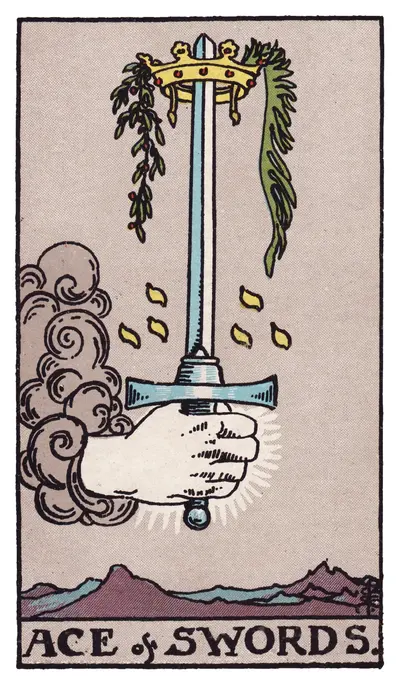
A hand emerges from a cloud gripping an upright sword, crowned with a wreath and a palm branch, over a bleak mountain landscape. Six small yod-shaped marks fall around it. The Ace of Swords is clarity — the moment something becomes clear, a decision is made, or a truth is stated — and it is the sharpest card in the deck in both senses. What distinguishes it from the other Aces is that its gift has an edge. Clarity is useful and it cuts; knowing exactly what is happening is not always comfortable, and the card makes no attempt to soften that. When it arrives, something is about to be understood or said plainly. It is among the most actionable cards in the deck, because unlike the other three Aces it carries an instruction: the sword is upright and the reader is meant to notice which way it points. All four Aces share a composition used nowhere else in the deck — a hand from a cloud, one emblem, no figure — and the shared grammar is the tradition saying that an Ace is an availability rather than an act. What separates this one is the grip. The other three hands present their emblem; this one closes around the hilt, which is the difference between being offered something and being handed a tool. It is also the only Ace whose emblem is crowned, and the crown carries both olive and palm, mercy and severity together. The tradition is qualifying the gift at the moment of giving it, which it does for no other suit.
Reversed meaning
Reversed, the blade turns. The commonest reading is confusion rather than clarity — the decision unmade, the fact unavailable, which is straightforwardly the opposite of the upright card. A second and sharper reading is clarity misused: truth deployed as a weapon, which the upright card is always one step from and which the reversal makes explicit. A third concerns the querent holding back something they know, which is a specific and common situation. Where the reading involves other people the second is worth weighing; where it involves a decision, the first.
The root of Air
Air is the element of mind, language and distinction, and the Ace is that faculty in its raw state — not an argument, not a conclusion, but the capacity to see one thing as separate from another. That is why the emblem is a blade rather than a book. In the Golden Dawn scheme each Ace governs a quadrant of the heavens rather than a sign, which is why no chart position can resolve to one: a planet at 8° Gemini is a specific place, and the root of air is wherever air is.
What is on the card
The crown on the sword’s point carries both an olive branch and a palm — mercy and severity, the two pillars — which is the tradition placing a qualification on the blade at the exact moment it is offered. Six yods fall around it, the same marks that appear on the Tower and the Moon, generally read as grace descending. The mountains below are jagged and bare, the harshest landscape in the Minor Arcana. The hand grips rather than presents, and the sword is perfectly vertical. Nothing in the image is soft.
In a love reading
Truth arriving in a relationship, which can be a conversation that clears the air or one that ends it — the card does not distinguish and should not be made to. It is common in questions about whether to say something, where its answer leans toward yes and says nothing about the consequences. On questions about understanding a situation it is one of the clearest affirmatives in the deck: the fog is about to lift. It reads poorly on questions about comfort, since nothing in this card is gentle.
In a career reading
A decision made, a problem understood, a proposal stated plainly. It is among the strongest cards for questions about strategy and about cutting through a situation that has become tangled. On questions about negotiation or legal matters it is favourable and specific. Its practical contribution is that clarity is a tool rather than a comfort: the card indicates the querent is about to know what is actually going on, and knowing is generally the beginning of work rather than the end of worry.
How this one is usually misread
The frequent error is reading this as victory, which the crown and the palm encourage and the card does not support. An Ace is a beginning, and what begins here is understanding rather than success — the Six of Wands is victory and looks nothing like this. The second misreading is treating the clarity as automatically welcome. The blade is double-edged and the landscape below it is the bleakest in the suit, and a reading that promises relief has ignored the tradition’s own qualification: the crown carries mercy and severity together, and the card does not say which is arriving. A third error is specific to questions about conflict. The sword is offered rather than swung, and the card indicates that the querent is about to understand something — not that they are about to prevail. The Five and the Six of Swords are what winning and leaving look like, and neither resembles this.
How it behaves beside other cards
With the Two of Swords the blindfold comes off, which is the most constructive pairing either card has. Beside the Eight of Swords the reasoning that holds the situation in place is cut through. With the Three of Swords the Ace identifies the thing that was said. Next to the Seven of Swords the whole arrangement is exposed plainly. Its most severe neighbour is the Ten of Swords, where the clarity arrives after the ending rather than before it. Beside the Page of Swords somebody has found the thing out and is about to say it. With the Two of Cups the clarity concerns a relationship rather than a situation. Next to the Nine of Swords the truth arrives and is considerably smaller than the night spent anticipating it, which is the most useful thing this pairing does. Beside the Hermit the clarity is arrived at alone rather than through anybody else, which is how most of it actually happens.
Why this card has no degrees
The four Aces are the root of their element rather than a place in the zodiac. Ace of Swords is the root of Air. A card with no span cannot be drawn from a chart position, which is exactly why the spread tool never returns one.
Correspondences follow the Golden Dawn attributions set out in Book T. Degrees are computed from each card’s position in the decan sequence rather than transcribed, so they cannot drift from the spread tool on the rest of this site.
Cards next to this one
See this card come up in your own chart
The spread on our tarot astrology page reads your chart positions as cards — no shuffle, the same answer every time. The daily card does the same for the Moon’s decan right now.