Stations retrograde
19.7° Gemini
Stations direct
3.2° Gemini
Stations computed from the ephemeris to the minute, and shown in your timezone rather than ours.
Venus is retrograde once in 2028.
Times shown in UTC
A retrograde is an apparent reversal, not a real one. Venus keeps orbiting the Sun in the same direction throughout; seen from a moving Earth, it traces a backward loop against the fixed stars for a few weeks before resuming.
The two moments that bracket that loop are called stations — the instant the apparent motion stops and turns. They are the most confidently datable events in transit astrology, because a station is a sign change in speed rather than a matter of interpretation. Everything on this page is measured from those two instants.
It is worth being precise about what does and does not change. The planet’s orbit is unaffected; so is its distance, its brightness and everything else physical. What changes is the direction it appears to travel against the background stars, as seen from here. Astrology has always built on that appearance rather than denying it — the symbolism of a planet retracing ground it has already covered is a statement about perspective, which is exactly what the geometry describes.
This matters for reading any calendar of retrogrades, including this one. The dates are astronomical facts and can be checked against any ephemeris. What those dates are taken to mean is interpretation, and the two should not be presented as though they carried the same kind of authority.
Because the planet turns around, it covers the same stretch of zodiac three times: forward, backward, then forward again. The shadow is simply the first and third pass. The pre-retrograde shadow begins when the planet first reaches the degree it will later station direct at, and the post-retrograde shadow ends when it climbs back to the degree it originally turned from.
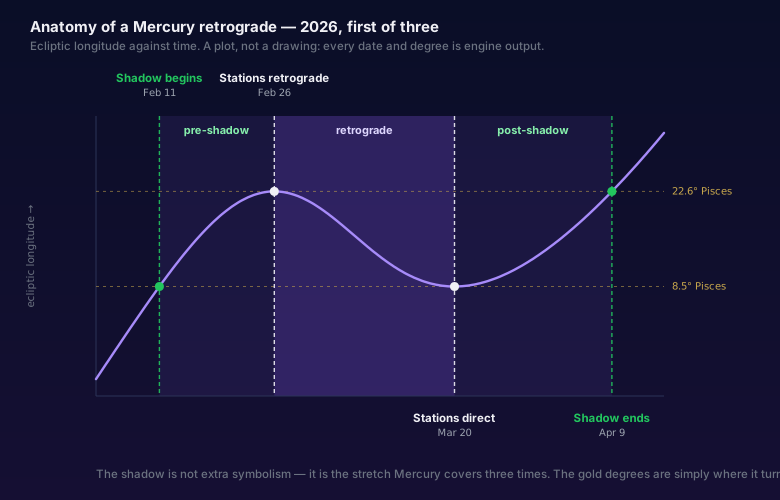
This is why the shadow dates are not extra symbolism layered on top. They fall out of the geometry, and you can check them against any ephemeris.
The practical consequence is that a retrograde is longer than it looks. By the time the planet finally clears the degree it first turned back from, it has spent roughly twice the headline duration inside the same stretch of zodiac. Anything begun in the pre-shadow tends to come back around during the retrograde proper, and to settle only once the post-shadow closes — which is why the four dates on this page are more useful than the two most sites publish.
The shadow is also the least mystical part of the whole subject, which is why it is worth understanding first. There is no judgement involved in locating it: you take the degree of each station and ask when the planet crossed it. Two lookups, no interpretation. If a source gives you shadow dates that do not line up with the station degrees it publishes, one of the two is wrong.
Positions come from astronomy-engine, an open-source ephemeris, computed geocentrically — the frame astrology uses. To find a station we sample the planet's speed coarsely to bracket the moment it changes sign, then bisect inside that bracket down to the second. Speed itself is measured symmetrically around each instant rather than forward from it, which sounds like a detail and is not: a forward difference reports the speed of half a day later, and it moved two of the six 2026 Mercury stations onto the wrong calendar day until we fixed it.
The published dates for a reference year are pinned by an automated test in our repository, so a change to the engine fails the build rather than quietly shifting the dates you read here.
Two details are worth stating because they are the usual sources of error elsewhere. The first is the coordinate frame: the same ephemeris library will happily return heliocentric longitudes, which are a different quantity and in which retrograde motion does not exist at all — seen from the Sun, no planet ever appears to reverse. The second is that a retrograde planet crosses the same degree up to three times, so any search that assumes one crossing per degree will silently return whichever it happens to find first.
The honest version of retrograde advice is narrower than the popular version, and more useful. A station is a date. What it licenses is a change in your own scheduling — leaving margin, building in a second look, choosing to revisit rather than launch. It does not license a prediction that something will go wrong, and any source that tells you otherwise is selling anxiety rather than timing.
The distinction shows up clearly in how the two kinds of statement fail. "Leave room to re-read the contract before you sign" costs you twenty minutes if the symbolism means nothing, and saves you a great deal if it means something. "You will have a misunderstanding this week" is either a hit or a miss, teaches you nothing either way, and quietly encourages you to interpret ordinary friction as confirmation. Only one of those is worth organising a calendar around.
Used that way, the shadow dates become the practical part. The pre-shadow is a reasonable prompt to finish or firm up what is already in motion; the retrograde itself suits review, revision and returning to unfinished work; the post-shadow is when things settle rather than when they begin. None of that requires believing anything in particular about planets. It is a scheduling heuristic with dates attached, and the dates are real.
A calendar of stations is a calendar of one thing. It says nothing about the rest of the sky on those days, nothing about which of them coincide with something else worth noticing, and nothing about your own chart. A period that looks significant here can be entirely unremarkable in a full transit reading, and an unremarkable-looking one can matter a great deal if it lands on a sensitive degree.
That is the reason this page ends by pointing at a chart rather than at a longer horoscope. The dates are universal and free, and they are as far as universal information can honestly take you. Everything past that point depends on where the station falls for you specifically.
These dates are identical for everyone on earth. What differs is where the station lands in your own chart — the same degree can sit on your career angle or in the quiet twelfth house, and that is what decides whether it is worth planning around.
The same minute, two readings
The difference is not subtle. A station on the degree of your Midheaven touches the part of the chart that describes your public work; the same station four degrees earlier might fall in the twelfth house, where the tradition says almost nothing surfaces. Same sky, same minute, two readings that share nothing but the date.
This is also the honest boundary of a page like this one. Universal dates are free because they cost nothing to produce and belong to everyone. Working out which of them lands where in your chart takes your birth time and place, and that is where a calendar stops and a chart begins.
Free, and it uses the same engine as this page.