Minor Arcana · Pentacles · earth
Page of Pentacles
The Book T title
The Princess of the Echoing Hills, and as with the other Pages the office is a quadrant of the heavens — the earthy quarter — rather than a span of the zodiac. The Golden Dawn treats the Princesses as the thrones on which their elements rest, which is a considerably weightier role than the English "page" conveys, and it fits this figure better than most: nothing about the Page of Pentacles is hurried.
Upright meaning
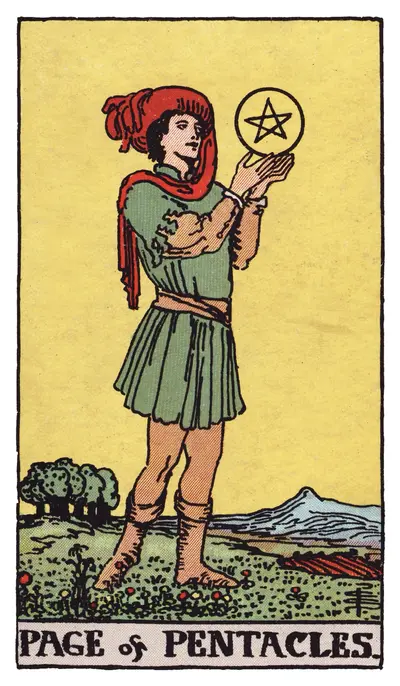
A young figure stands in a ploughed field holding a pentacle up in both hands and studying it, with trees and a small wood behind and mountains beyond. Nothing is happening. The Page of Pentacles is study — the beginning of a practical undertaking, approached with attention rather than enthusiasm, which separates it sharply from the Page of Wands. The figure is not excited; they are concentrating. When it arrives, the thing being asked about involves learning something with a material outcome: a course, a trade, a first attempt at managing money or building something. As a message this Page traditionally carries news about work, study or a practical offer. The ploughed field is the card’s quiet point — the ground has already been prepared, so the study is happening in a situation that will support it rather than in the abstract. Every Page is a messenger as well as a person, and the older reading sits underneath the modern one. The rank arrives with word from elsewhere and the suit determines the kind: for Pentacles it is news with a material consequence — an offer, a sum, an acceptance, a date for something practical. It tends to arrive on paper rather than in conversation, and it tends to require a decision rather than a reaction. When this card appears in a spread about a situation rather than a person, the useful question is what has recently been confirmed, since this is the messenger who brings the version with the figures in it.
Reversed meaning
Reversed, the study fails to convert. The commonest reading is learning without application — knowledge accumulated and never used, which is the rank’s specific failure in this suit. A second concerns commitment: an undertaking begun and not sustained, which is common enough to be worth naming plainly. A third is favourable and frequently right: a slow start rather than a failed one, since nothing about this figure was ever going to be quick.
Why this card spans two signs
The Pages hold no 20-to-20 span. Where the other three court ranks each straddle two signs, a Page rules a quadrant of the heavens — for Pentacles, the earthy quarter. That is why a chart position never resolves to a Page: the twelve spanned courts occupy thirty degrees of the wheel apiece and the Pages occupy a quarter of the sky each. It also accounts for the rank’s elemental purity, since there is no second sign to modify them.
Read as a person
Read as a person, the Page of Pentacles is a student in the broad sense — someone learning something with a practical end, carefully and without much display. They are reliable, slow to commit and slower to abandon, and their characteristic strength is that they will actually finish the reading. In readings about other people this figure is often the one quietly acquiring a capability nobody has noticed. As the querent it describes being genuinely at the start of something material and taking it seriously, which the deck treats as the most promising of the four Page positions.
What is on the card
The pentacle is held up at eye level in both hands and the figure is looking directly at it — the only court card studying their own suit emblem rather than wielding it. The field beneath has been ploughed in visible furrows, so work has already been done here. A copse of young trees stands behind and mountains rise in the distance. The tunic is green and the hat is red and substantial. Both feet are planted, which no other Page manages.
In a love reading
A relationship being approached seriously and slowly, or somebody learning how to be in one. It is the least romantic of the four Pages and the most durable. On questions about whether someone is serious it is favourable and quiet. It also appears in relationships where a practical undertaking is the thing being built together, which the Three of Pentacles takes further. On questions about pace it is the clearest slow answer in the deck, and the slowness is not reluctance — the figure is studying the thing in their hands rather than looking around for something better.
In a career reading
Study, training, an internship, a first job in a field, the deliberate acquisition of a skill. It is among the strongest cards in the deck for questions about whether to learn something, and its answer is consistently yes with a long timescale attached. On questions about money it indicates learning to handle it rather than having it. It also describes a colleague who is more capable than their position suggests.
How this one is usually misread
The habitual error is the one all four Pages attract: reading the rank as a child. A Page is someone at the beginning of a thing, and for this suit the card most often describes an adult acquiring a practical skill. Delivered as "a young person" in a question about work it points the querent at the wrong figure entirely. The second misreading is treating the card as merely preparatory, as if nothing were happening yet. The field is already ploughed and the figure is already studying — the work has started, and the slowness is the method rather than a delay.
How it behaves beside other cards
With the Eight of Pentacles the study becomes practice, which is the suit’s natural progression. Beside the Ace of Pentacles the offer and the willingness to learn arrive together. With the Three of Pentacles the apprentice is in the room with the craftsman. Next to the Four of Pentacles somebody wants to be given something and is not going to be. Its most encouraging neighbour is the Seven of Pentacles, where the patience this figure has is exactly what the situation asks for. Beside the King of Pentacles the student is in the room with somebody who finished the same apprenticeship decades ago. With the Two of Pentacles the study is being fitted around everything else, which is how most of it actually happens. Next to the Ten of Pentacles the learning is taking place inside a structure somebody else built. Next to the Hermit the study becomes solitary by choice rather than by circumstance, which suits this figure better than most. Beside the Wheel of Fortune the patient method meets something that will not wait for it, which is this figure’s one structural vulnerability. Beside the Queen of Pentacles the student has somebody to learn from who will also feed them, which is this suit at its most generous.
Why this card spans two signs
The four Aces are the root of their element rather than a place in the zodiac. Page of Pentacles is the root of Earth. A card with no span cannot be drawn from a chart position, which is exactly why the spread tool never returns one.
Correspondences follow the Golden Dawn attributions set out in Book T. Degrees are computed from each card’s position in the decan sequence rather than transcribed, so they cannot drift from the spread tool on the rest of this site.
Cards next to this one
See this card come up in your own chart
The spread on our tarot astrology page reads your chart positions as cards — no shuffle, the same answer every time. The daily card does the same for the Moon’s decan right now.