Minor Arcana · Pentacles · earth
Knight of Pentacles
The Book T title
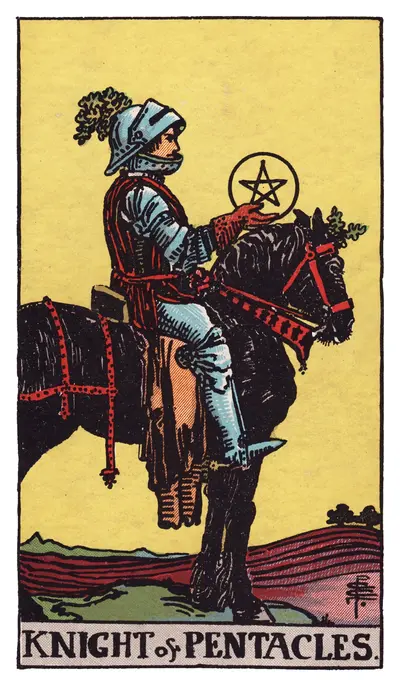
The Prince of the Chariot of Earth, and it is the only Prince whose chariot is standing still. The rank is the mobile, active expression of its element, and in earth that produces something the other three Princes do not have: a pace that can be maintained indefinitely. Book T’s earth Prince is not slow because he is dull. He is slow because the ground he covers has to be worked afterwards. Book T assigns each rank an element of its own, and the compound explains the court cards better than temperament ever does. The King is fire, the Queen water, the Knight air, the Page earth. This card is therefore air of earth — the lightest rank in the heaviest suit, which is the only reason this figure moves at all. Take the air away and there is nothing but ground. It is a precise account of the image: a rider whose horse is standing still, holding a pentacle and thinking about it. The motion in the card is entirely supplied by the rank.
Upright meaning
A rider in full armour sits on a heavy black horse that is standing completely still, holding a pentacle level in both hands, above a ploughed field with a treeline beyond. Nothing is moving. It is the only Knight whose mount is stationary, and the stillness is the entire card. The Knight of Pentacles is method — steady, reliable, unglamorous progress that arrives because it never stops rather than because it is fast. When it arrives, the thing being asked about is being handled by somebody who will finish it, and finishing will take exactly as long as it takes. The card is frequently read as boring and that reading is not wrong so much as incomplete: of the sixteen court cards this is the one whose work actually gets done, and the deck is quite deliberate about giving the least exciting figure the most reliable outcome.
Reversed meaning
Reversed, the method fails in one of two directions. The commonest reading is stagnation — steadiness that has become inertia, the horse standing still because it has stopped rather than because it is waiting. A second concerns rigidity: a method continuing after the situation it suited has changed, which is this figure’s specific blindness. A third is more favourable and worth offering: impatience with one’s own pace, which is uncomfortable and usually unwarranted. Where the reading involves a stuck project the first applies; where it involves a person, the second.
Why this card spans two signs
This Knight holds the last twenty degrees of Aries running into the first ten of Taurus, which is a surprising span for the deck’s most patient figure and explains something the image alone does not. The closing decans of Aries are initiating and forceful; the opening of Taurus is fixed and slow. A figure straddling that seam starts things decisively and then will not be hurried, which is exactly the combination that produces reliable delivery. The twelve spanned courts each cover thirty degrees, with the joins falling inside signs.
Read as a person
Read as a person, the Knight of Pentacles is someone who does what they said they would, on the timescale they said, without commentary. They are unexciting to work with and the only one whose estimates are accurate. Their characteristic weakness is that they will continue a method past the point where it stops fitting, because the method is how they know what to do. In readings about other people this figure is often the one quietly carrying the part of the work nobody has asked about. As the querent it indicates being on a slow and correct course. The sixteen court cards share one difficulty: each can be another person, the querent, or the situation, and the image never says. The tell in this one is that nobody claims it. Almost nobody identifies as the least exciting figure in the deck, so when it appears for the querent it tends to arrive as a description they would not have chosen and usually accept on reflection. Where it indicates another person it is generally somebody already doing the work rather than somebody about to arrive. As a situation it means a process that is running properly and will not be hurried.
What is on the card
The horse is a heavy draught animal, not a riding horse, and it is standing with all four feet planted — the only stationary mount among the Knights. The pentacle is held level in both hands and the rider is looking at it rather than ahead. His armour is complete and his visor is up. The field beneath has been ploughed into visible furrows and a treeline sits at the horizon. Oak leaves decorate the horse’s bridle and the rider’s helm, the tree that grows slowest and lasts longest.
In a love reading
A relationship built slowly by somebody who means it, or a partner whose reliability is the whole offer. It is unromantic and among the most durable court cards on a relationship question. On questions about commitment it is one of the clearest affirmatives in the deck, and on questions about passion it is honest: there is not much in this card. Where a querent is frustrated by someone’s pace, this card usually indicates that the pace is not reluctance.
In a career reading
Dependable execution, a long project being properly managed, a colleague who delivers. It is among the strongest cards for questions about whether something will be finished, and among the weakest for questions about whether it will be finished soon. On questions about whether to persist it is a plain yes. On questions about innovation it is poor, since the method in this card is the thing being defended rather than examined.
How this one is usually misread
The habitual error is reading this as dullness, which is accurate about the temperament and wrong about the outcome. Of the four Knights, three are in motion and this is the one whose work gets finished — the deck has deliberately given the least interesting figure the most reliable result, and a reading that treats him as an obstacle has inverted the point. The second misreading is confusing stillness with inaction. The horse is standing because the rider has stopped to look at what he is carrying, and the field behind him has already been ploughed. The work in this card is in the past tense as much as the future.
How it behaves beside other cards
With the Eight of Pentacles the method and the craft reinforce each other, which is the most productive pairing in the suit. Beside the Seven of Pentacles the waiting is being done by somebody constitutionally suited to it. With the Knight of Swords two incompatible speeds sit side by side and the reading is usually about which the situation needs. Next to the Eight of Wands the pace is about to be overtaken by events. Its most frustrating neighbour is the Ace of Wands, where an opportunity arrives that will not wait for this timescale. Beside the Hermit the slowness becomes solitary rather than merely steady. With the Three of Pentacles the method is working inside a team, which is where it produces the most and is noticed the least.
Why this card spans two signs
The twelve court cards above Page each cover the last twenty degrees of one sign and the first ten of the next, so the twelve of them tile the circle once with the seams falling inside signs rather than between them. Knight of Pentacles runs from Aries into Taurus. Pages take a whole seasonal quadrant instead and have no degree span.
Correspondences follow the Golden Dawn attributions set out in Book T. Degrees are computed from each card’s position in the decan sequence rather than transcribed, so they cannot drift from the spread tool on the rest of this site.
Cards next to this one
See this card come up in your own chart
The spread on our tarot astrology page reads your chart positions as cards — no shuffle, the same answer every time. The daily card does the same for the Moon’s decan right now.