Eclipse Calendar 2024
All 4 eclipses of 2024 — 2 solar and 2 lunar — computed to the minute and shown in your own timezone, with the zodiac degree each one falls on.
What 2024 looks like
The eclipse calendar 2024 holds 4 eclipses: 2 of the Sun and 2 of the Moon, arriving in 2 eclipse seasons.
That is the ordinary count. Four is what most years get, and the eclipses of 2024 follow the usual pattern — one solar and one lunar eclipse in each of the two seasons.
The deepest alignment of the year is on April 8, with the Sun 3.75° from a lunar node at 19.4° Aries. That number is the one that decides how central the eclipse is — the smaller it gets, the more squarely the shadow crosses.
Eclipses in 2024 land in Libra, Aries, Pisces. Because they can only happen near the nodal axis, and the axis moves slowly, a year's eclipses cluster into a small set of opposite signs rather than scattering round the zodiac.
The eclipses of 2024, in full
The 4 eclipses of 2024 on one axis, with the zodiac sign each falls in. The node gap column is what decides the depth of each — small numbers mean a central eclipse, and anything past about fifteen degrees would not be an eclipse at all.
| Instant | Type | Degree | Node gap | Covered |
|---|---|---|---|---|
| Lunar · PenumbralBarely visible — the Moon only dims | 5.2° Libra | 11.3° | 0% | |
| Solar · Total | 19.4° Aries | 3.8° | 100% | |
| Lunar · Partial | 25.8° Pisces | 11.4° | 4% | |
| Solar · Annular | 10.1° Libra | 3.8° | 87% |
Lunar · Penumbral
- Degree
- 5.2° Libra
- Node gap
- 11.3°
Barely visible — the Moon only dims
Solar · Total
- Degree
- 19.4° Aries
- Node gap
- 3.8°
Lunar · Partial
- Degree
- 25.8° Pisces
- Node gap
- 11.4°
Solar · Annular
- Degree
- 10.1° Libra
- Node gap
- 3.8°
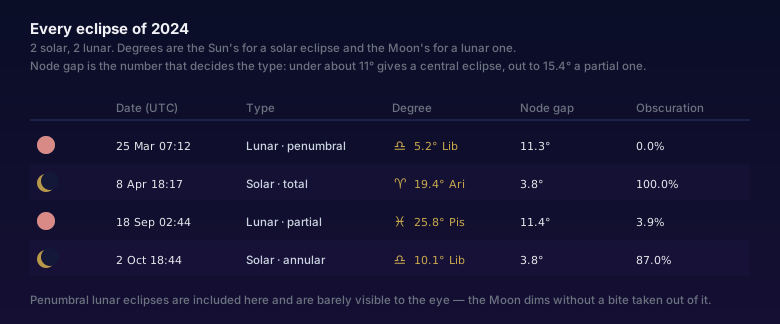
Each eclipse of 2024, in order
March 25 — a penumbral lunar eclipse at 5.2° Libra. The Moon crosses only the faint outer shadow and dims slightly; without a photograph taken before and after, almost nobody notices.
April 8 — a total solar eclipse at 19.4° Aries. The Moon covers the Sun completely, but only along a band roughly a hundred kilometres wide; everywhere else on the daylit side sees a partial phase.
September 18 — a partial lunar eclipse at 25.8° Pisces. Part of the Moon enters the dark shadow, giving it a visible bite for an hour or two.
October 2 — an annular solar eclipse at 10.1° Libra. The Moon is far enough from Earth to look slightly too small, so a ring of sunlight is left around it. There is no moment when it is safe to look without a filter.
The eclipse seasons of 2024
The eclipses of 2024 do not spread themselves through the year. They arrive in seasons about a month long, when the Sun passes close enough to a lunar node for an alignment to be possible, and within a season a solar and a lunar eclipse fall roughly a fortnight apart.
The eclipses of 2024 fall into the usual two seasons.
Season 1
March 25 to April 8 · 2 eclipses
Season 2
September 18 to October 2 · 2 eclipses
Some of these you will not see
1 of the lunar eclipses in 2024 are penumbral: the Moon passes only through the Earth's faint outer shadow and dims slightly rather than darkening or turning red.
Why they are listed at all
They are listed here because they are real eclipses and because leaving them out without explanation is how a calendar ends up looking wrong to anyone comparing it with another. But if you go outside expecting a spectacle you will see an ordinary full moon.
The kinds of eclipse 2024 brings
A total solar eclipse, where the Moon covers the Sun completely — visible only from a narrow band, and only for minutes.
An annular solar eclipse, where the Moon is too far from Earth to cover the Sun and leaves a ring of light. Never safe to view without a filter, at any point.
Why the eclipses of 2024 land where they do
The signs the eclipses of 2024 fall in are not chosen and they are not symbolic in origin. An eclipse can only occur when the Sun is close to one of the two points where the Moon's orbit crosses the plane of the Earth's — the lunar nodes — and those two points sit opposite each other in the zodiac.
The degrees are pinned to the nodal axis
So the eclipse degrees of any year are pinned to wherever the nodal axis happens to be. The nodes drift backwards about 19° a year, which is slow enough that a single axis governs eclipses for roughly eighteen months and fast enough that no two consecutive years look quite alike.
Which is why the signs cluster
That is why the eclipse calendar 2024 shows a small cluster of signs rather than a spread. It is also why comparing one year against the next tells you more than looking at either alone, and why the neighbouring years are linked at the bottom of this page.
Using the eclipse calendar 2024
There are two honest ways to use a page like this, and one dishonest one.
The observational use
The first is observational. Find the eclipses of 2024 visible from where you are, note the local time, and for a solar eclipse arrange proper filters well in advance. A lunar eclipse needs nothing but a clear sky and the patience to watch for an hour.
The astrological use
The second is astrological, and it depends on the degree column rather than on the date. Compare the degrees above against your own chart; the ones that touch something are the ones worth attention. Nothing about the year's eclipses is personal until that comparison is made.
The dishonest use
The dishonest use is treating a date as a forecast. An eclipse does not schedule events and no reading can tell you what will happen to you on a given day. What the tradition offers is a way of timing your own attention, which is a much smaller claim and the only one made here.
The rhythm of 2024
The first eclipse of the year falls on March 25 and the last on October 2, leaving a stretch of 162 days between the end of one season and the start of the next when no alignment is possible at all.
The quiet stretch is geometry, not a lull
That quiet stretch is not a lull in activity so much as a consequence of geometry: the Sun has moved away from both nodes and cannot come near either until it has travelled far enough round the ecliptic. The interval between eclipse seasons averages about 173 days, which is why the seasons of 2024 sit roughly three weeks earlier than the year before rather than on the same dates.
Inside a season the spacing tightens
Within a season the spacing is much tighter. A solar and a lunar eclipse fall about a fortnight apart because they need the same node from opposite ends: the Sun near it for one, the Sun near it and the Moon opposite for the other. Half a lunar month separates the two conditions.
The deepest alignment of 2024
Of the 4 eclipses this year, the one on April 8 at 19.4° Aries comes nearest to a node, at 3.75°. It is a Solar · Total, and 100% of the disc is covered at greatest eclipse.
Why node gap is the ranking figure
Node gap is worth understanding because it is the one figure that ranks the eclipses of 2024 — or any year — honestly. Depth of shadow, width of the visible band and duration all follow from how squarely the shadow axis meets the Earth, and that is what this number measures. Everything past about fifteen degrees produces no eclipse at all.
What it does not measure
What it does not measure is whether you will see anything. A deep eclipse over open ocean is invisible to almost everyone, and a modest partial one over a populated continent is watched by millions. Depth and visibility are separate questions, and only the first is a property of the eclipse itself.
Which of these touch your chart
Every degree in this eclipse calendar 2024 is the same for everyone. What differs is whether any of them sit close to something in your own chart — a planet, an angle, the opposite point, or a square.
Which placements are most directly touched
With the eclipses of 2024 concentrated in Libra, Aries, Pisces, the placements most directly involved are the ones in those signs and the ones opposite them. If you have nothing there, this year's eclipses are astronomy rather than astrology as far as you are concerned.
Generate your birth chart free and compare it against the degrees above.
Calculate my birth chartFrequently asked questions
- How many eclipses are there in 2024?
- 4: 2 solar and 2 lunar, arriving in 2 eclipse seasons. That puts the eclipses of 2024 within the normal range — a year can hold as few as four and as many as seven.
- Which is the most significant eclipse of 2024?
- By alignment, the one on April 8 at 19.4° Aries, which sits 3.75° from a lunar node — the closest of 2024. Depth is not the same as visibility, though: whether you can see it depends entirely on where you are.
- How accurate is the eclipse calendar 2024?
- They are computed from the ephemeris rather than copied from another calendar, and the degrees agree to the arcminute with astrology publishers who list the same eclipses independently.
- Why does a date here differ from another site by a day?
- Timezone. These instants are rendered in your own zone; most sites publish UTC. An eclipse late in the UTC evening is already the next day in Europe and still the previous one on the American west coast.
- Is this free?
- Yes, with no signup and no limit. These are public astronomical facts. What is paid on this site is the interpretation of your own chart.
- Will the 2024 eclipses affect me?
- Only if one of the eclipses of 2024 lands on something in your chart. The degrees are listed above precisely so you can check rather than guess.
Other years
Eclipse patterns only make sense across several years, because the nodal axis takes about eighteen months to move on and a saros series takes eighteen years to come round. The eclipse calendar {year} is one frame of a much longer sequence.