How to Read a Transit Chart: A 5-Step Guide
Learn to read your transit chart step by step — houses, aspects, orbs and timing — then run your own chart free. No jargon, worked example included.
One birth chart produces 327 distinct transit windows over a single year. We measured it.
That number is why most people bounce off transit charts. Open one and you get a wall of dates with no indication which of them matters.
By the end of this guide you will be able to open any transit chart and say, in one sentence, what is happening and roughly when it peaks.
What you'll learn:
- Why the outer ring moves and the inner one never does
- The reading order professionals actually use — it is not left to right
- How to tell a transit that matters from one that doesn't
- What an orb is, and why "applying" changes the meaning
- What to do when you don't know your birth time
What a Transit Chart Actually Is

The one-sentence definition
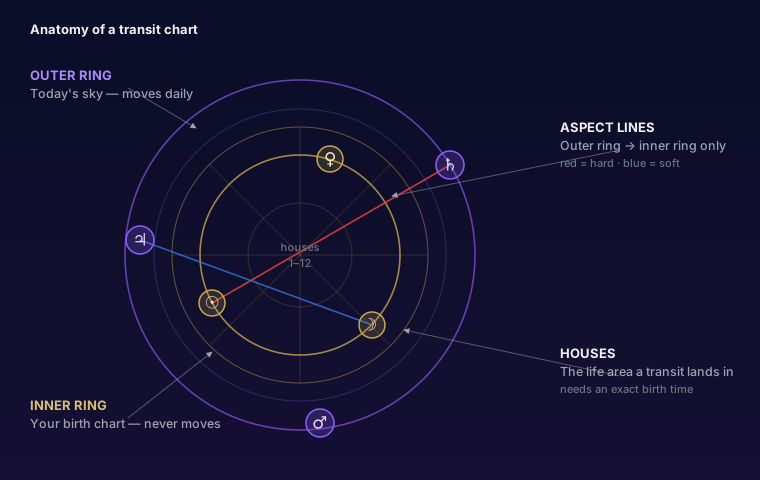
A transit chart is a two-ring chart that places the planets' current positions around your fixed birth chart, showing which parts of your natal chart the moving sky is touching right now.
That is the whole concept. Everything below is detail.
The two rings
The inner ring is your birth chart. It was set at the moment you were born and it never changes — not with age, not with a house move, never.
The outer ring is today. It holds the same planets at the positions they occupy in the sky right now.
| Inner ring | Outer ring | |
|---|---|---|
| What it is | Your natal chart | Today's sky |
| Does it move? | Never | Every day |
| What it tells you | Who you are | What is happening to you |
| Set by | Your birth moment | The current moment |
Come back tomorrow and the outer ring will have shifted. The inner one will be exactly where you left it.
How to say a transit out loud
Astrologers use a compact phrasing that sounds like jargon but is literally just geometry.
"Transiting Saturn is square your natal Sun" means: Saturn, in today's sky, is sitting 90 degrees away from the spot where the Sun was when you were born.
That is the entire sentence. No hidden meaning, no special vocabulary — a planet, an angle, and a second planet.
📝 Note: aspects between two transiting planets are happening to everyone alive today. They describe the sky in general, not your chart. On a page about you, they are noise — which is why our free transit chart calculator draws only the lines that cross between the rings.
Before You Start: What You Need
Birth date, time and place
Three inputs, and they do not carry equal weight.
| Input | Why it matters | What breaks without it |
|---|---|---|
| Birth date | Fixes every planet's position | Nothing works |
| Birth time | Fixes the house cusps and Ascendant | Houses become unreliable |
| Birth place | Fixes the local horizon | Houses become unreliable |
Your birth date alone gets you every aspect in the chart, accurately. Aspects depend only on longitudes, and longitudes barely move over a day for anything except the Moon.
Houses are the part that needs the exact time. We come back to this in the mistakes section, because it is where most bad readings start.
Where to generate the chart
You need a tool that draws both rings and lists the transit-to-natal aspects with their orbs.
You can run yours on our transit chart calculator — it is free, needs no account, and shows the complete data rather than a teaser. Set the transit date to today to start, then move it once you are comfortable.
The 5-Step Reading Order
Here is the whole method. Read it once, then use the sections below for detail.
- Find the outer ring — that is today's sky
- Read the slow planets first — Saturn, Uranus, Neptune, Pluto
- Note which natal house each transiting planet is in
- Read aspects between the rings, never within one
- Check the orb — under about 1° is full strength

Step 1 — Find the outer ring
Orient yourself before you interpret anything.
On our chart the outer glyphs are violet and the inner ones are gold. Whatever tool you use, confirm which ring is which before reading a single aspect — misreading the rings is the most common beginner error, and it inverts the entire meaning.
If you only remember one thing about two-ring charts: outside moves, inside doesn't.
Step 2 — Read the slow planets first
Go straight to Saturn, Uranus, Neptune and Pluto. Ignore everything else on the first pass.
These bodies take years to cross a single sign. When one contacts a natal planet, the effect is measured in months or years, and it defines the whole period.
| Planet | Time per sign | A contact lasts | Read it? |
|---|---|---|---|
| Pluto | ~12–30 years | 1–3 years | First |
| Neptune | ~14 years | 1–2 years | First |
| Uranus | ~7 years | ~1 year | First |
| Saturn | ~2.5 years | 6–12 months | First |
| Jupiter | ~1 year | 2–8 weeks | Second |
| Mars | ~6 weeks | 3–10 days | Last |
| Sun / Venus / Mercury | ~1 month | 2–5 days | Last |
| Moon | ~2.5 days | 2–6 hours | Last |
Why speed equals importance
A slow planet stays in contact long enough for something to actually develop around it.
The Moon forms an exact aspect to something in your chart several times a day and is gone within hours. There is nothing there to plan around.
Step 3 — Note the natal house
The house tells you which area of life the transit is operating in.
Natal houses, not today's houses
Read the house the transiting planet occupies in your natal chart, not in a chart cast for today.
"Saturn is in my 11th" is a statement about your chart. Houses cast for right now describe the sky at your birthplace this afternoon, which is a different and far less useful question.
| House | Life area | House | Life area |
|---|---|---|---|
| 1st | Self, body, appearance | 7th | Partnership, close others |
| 2nd | Money, values, resources | 8th | Shared resources, depth |
| 3rd | Communication, siblings | 9th | Travel, study, belief |
| 4th | Home, family, roots | 10th | Career, public role |
| 5th | Creativity, romance, play | 11th | Friends, groups, hopes |
| 6th | Work, routine, health | 12th | Solitude, the unconscious |
Step 4 — Read between the rings, not within one
Draw your attention only to lines that start in the outer ring and end in the inner one.
A square between two transiting planets is happening to every person on Earth today. A square from a transiting planet to your natal planet is happening to you.
The four aspects worth learning first
There are more than four, but these carry most of the weight.
| Aspect | Angle | Symbol | What it tends to feel like |
|---|---|---|---|
| Conjunction | 0° | ☌ | Fusion — the transit becomes that part of you |
| Square | 90° | □ | Friction, pressure to act |
| Trine | 120° | △ | Ease, flow, often unnoticed |
| Opposition | 180° | ☍ | Tension between two poles, often via other people |
Conjunctions from slow planets are the ones that reshape a period. Start there.
Step 5 — Check the orb and direction
The orb is how far the aspect is from exact, measured in degrees.
Under roughly 1°, a transit is at full strength. Beyond 6–8°, most astrologers stop counting it.

Applying vs separating
This is the detail that changes a reading most and gets skipped most.
An applying aspect is still tightening — the theme is building, and the peak is ahead of you. A separating aspect has already peaked and is fading out.
Two transits with the same name can mean opposite things depending on which side of exact they sit.
💡 Pro tip: practise on the Moon, even though it is the least important body. It crosses your entire chart every 27 days, so you get a complete feedback cycle in four weeks instead of waiting years for Saturn to prove you right.
Which Transits Actually Matter

The 327 problem
We ran the numbers on our own engine: one chart, one year, 327 distinct transit windows.
No one can act on 327 dates. Most tools hand you all of them as an undifferentiated list and call it a feature.
Rarity is the ranking
Significance tracks orbital period almost perfectly.
The Sun travels the whole zodiac every year, so it necessarily forms every possible aspect to every planet in your chart, every year, without exception. That is not a signal — it is a metronome.
Saturn conjunct your natal Sun, by contrast, happens once or twice in an entire lifetime.
The test to apply
Ask one question of any transit: will I see this again next year?
If yes, it is weather. If no, it is a chapter.
| Body | Full cycle | Times in an 80-year life | Worth planning around? |
|---|---|---|---|
| Moon | 27 days | ~1,080 | No |
| Sun | 1 year | 80 | No |
| Mercury / Venus | ~1 year | ~80 | Rarely |
| Mars | 2 years | ~40 | Sometimes |
| Jupiter | 12 years | ~7 | Yes |
| Saturn | 29 years | 2–3 | Always |
| Uranus | 84 years | ~1 | Always |
| Neptune / Pluto | 165–248 years | 0–1 | Always |
The twenty that survive
Rank by rarity and roughly twenty windows a year are left standing.
That is a number a person can actually hold in their head and plan around. Everything else is background weather.
This is the one job a good transit tool should do for you, and almost none do.
A Worked Example
📝 Note: this is an illustrative chart, not a real person's. The birth data is made up; every date and degree below is genuine output from our calculation engine for that data.
The chart
Someone born 31 March 1990, 8:30am, Chicago. Their natal Sun sits at 10.62° Aries.
We will read their chart for 15 September 2026.

Walking the five steps
What the fast transits looked like
On that date, the tightest aspect in the whole chart is the Moon square natal Mars, orb 0.52°.
It is the closest to exact on screen, so it looks like the headline. It lasts about five hours.
There are three more sub-1° aspects that day involving Jupiter and Venus. All of them will be gone within days.
What the slow transit was actually doing
Transiting Saturn sits at 12.75° Aries, retrograde, in the natal 11th house — 2.1° from that natal Sun at 10.62°.
Saturn entered orb of this conjunction on 8 March 2026 and does not leave until 15 April 2027.
Inside that window it crosses the exact degree three separate times, because it stations retrograde partway through:
| Pass | Exact date | Motion |
|---|---|---|
| 1 | 14 May 2026 | Direct |
| 2 | 13 October 2026 | Retrograde |
| 3 | 5 February 2027 | Direct |
Saturn's retrograde stretch runs 26 July to 10 December 2026, which is why the middle pass happens backwards.
The reading in one sentence
The wrong reading: "Moon square my Mars — today is going to be awful."
The right reading: "Saturn is crossing my natal Sun across three passes between May 2026 and February 2027, and I am currently in the middle one."
The first sentence describes an afternoon. The second describes a year, and it is checkable against the table on the same page.
Three Mistakes Beginners Make
Treating every aspect as equal
The tightest orb on screen is rarely the most important thing in the chart.
Orb tells you how exact an aspect is. It says nothing about how rare or how long-lasting it is.
The fix
Sort by the transiting planet's speed first, then compare orbs only within the same speed tier.
A Saturn contact at 3° outranks a Moon contact at 0.1°, every time.
Reading a triple pass as three events

Most tools list the three passes above as three separate events on three separate dates.
Nobody experiences it that way. It is one long period with three intensity peaks, and it should be read as one.
If your tool shows the same aspect three times months apart, that is not three things happening — check whether the planet stations retrograde in between.
Trusting houses without a birth time
If you do not know your birth time, house placements are not merely approximate — they are unknowable.
A noon default produces cusps that are simply wrong, and dating a real event to an arbitrary house puts it on the wrong part of your life.
Our calculator drops house transits entirely when the birth time is unknown, rather than showing you a confident-looking number derived from a guess. Every aspect still works. If you want to narrow your birth time down first, start with the rising sign calculator.
Quick Reference
The whole method on one screen.
| Step | Look at | Ask | Skip if |
|---|---|---|---|
| 1 | Which ring is which | Is this glyph transiting or natal? | — |
| 2 | Saturn → Pluto | Is a slow planet touching a natal planet? | Nothing slow is in orb |
| 3 | Natal house | Which area of life? | Birth time unknown |
| 4 | Lines between rings | Which natal planet is being hit? | Both ends are transiting |
| 5 | Orb + direction | Under 1°? Applying or separating? | Orb over ~8° |
Frequently Asked Questions
What is a transit chart in astrology?
A transit chart is a two-ring chart that places the planets' current positions around your fixed birth chart, showing which parts of your natal chart the moving sky is touching right now. The inner ring never changes; the outer ring changes every day.
How do you read a transit chart step by step?
Five steps: identify the outer ring as today's sky; read the slow planets — Saturn, Uranus, Neptune, Pluto — first, because they define periods measured in months or years; note which natal house each transiting planet occupies; read only the aspects between the two rings; then check the orb, which is strongest under about 1°.
Which transits are the most important?
The rarest ones. Significance tracks orbital period: the Sun aspects every planet in your chart every year and carries almost no planning information, while Saturn conjunct your natal Sun happens once or twice in a lifetime. Of the 327 transit windows a chart produces in a year, roughly twenty are worth attention.
Can I read a transit chart without knowing my birth time?
Yes, partly. Every aspect stays accurate because aspects depend only on longitudes. House placements do not — they need exact cusps, so an unknown birth time makes them unreliable. Our calculator hides house transits entirely in that case rather than estimating them from a noon default.
How often should I check my transits?
Monthly is enough for most people. Fast bodies change weekly but rarely matter on their own, and the transits worth planning around come from Jupiter outward and last months. Instead of checking daily, move the date forward to see what is coming.
Next Steps
Run your own chart on the free transit chart calculator and find your slowest transiting planet. That single placement will tell you more about the current chapter of your life than every fast aspect combined.
Then read your solar return chart for the year-level view. Transits and the solar return answer the same question at different resolutions — and how to read a solar return chart picks up where this guide stops.
If you have not looked at your natal birth chart yet, start there instead. A transit chart is measured against it, and without that foundation there is nothing for the transits to land on.
Author

Categories
More Posts

Solar Return Chart vs Birth Chart: Key Differences Explained
Understand the key differences between your solar return chart and your birth chart. Learn how these two astrology charts work together to give you a complete picture.

Solar Return Chart Meaning: Your Annual Cosmic Blueprint
Learn what your solar return chart means and how to interpret its key elements. Understand the significance of planet placements, aspects, and house positions in your annual chart.

Solar Return Chart Houses: What Each House Means for Your Year
Learn what each of the 12 houses means in a solar return chart. Understand where the action will be in your year ahead based on planet placements in houses.
Newsletter
Join the community
Subscribe to our newsletter for the latest news and updates